Will AI make auditors obsolete, or make attackers rich first?
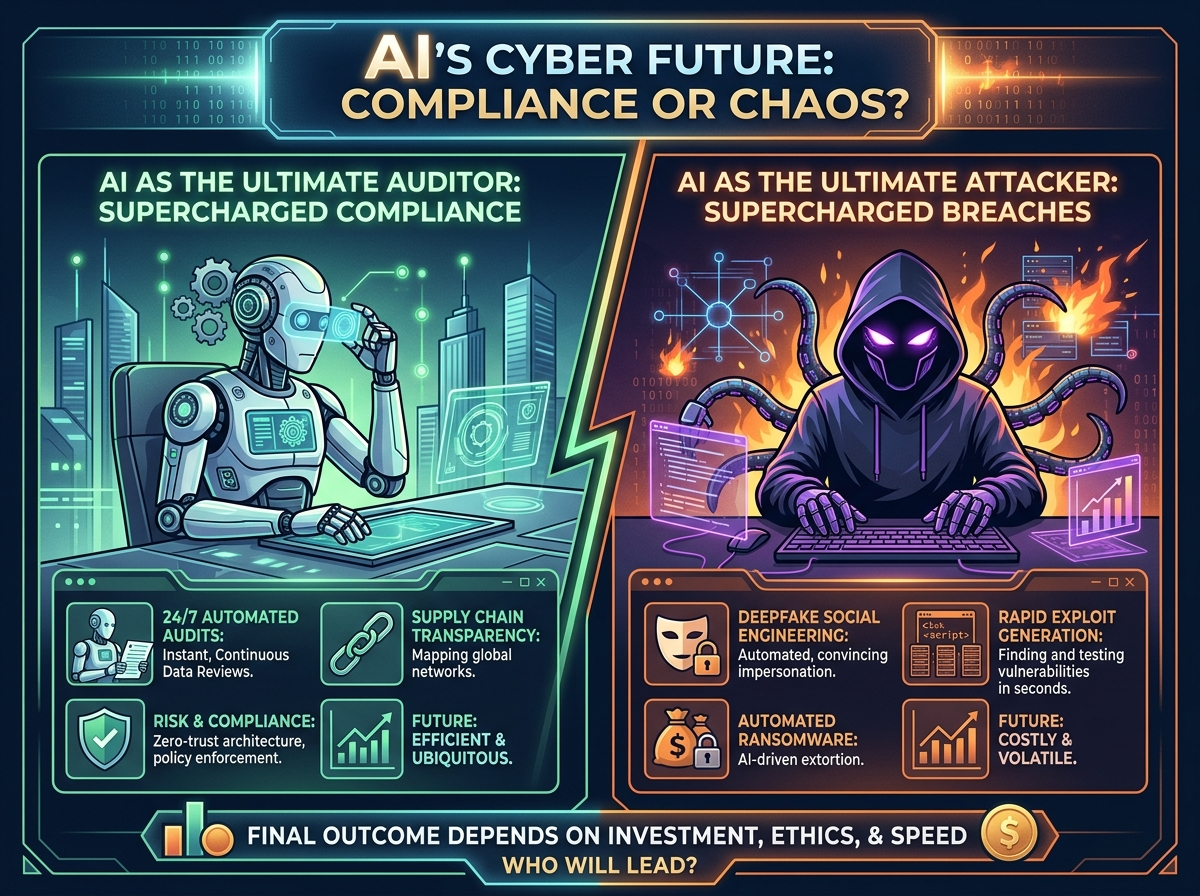
AI is already helping scammers move faster than regulators can react, but it is not replacing auditors so much as forcing them to prove more, document more, and own more. The near-term winner looks like attackers; the durable winner will be the side with better governance.
Shuja Abrar · Blockchain Consultant & Engineer
- ai
- auditing
- fraud
- cybercrime
- regulation
On this page
As of late October 2026, AI is already changing both sides of the audit equation. The Financial Reporting Council has published the first audit-regulator guidance globally for generative and agentic AI in audit engagements, the IAASB is proposing revisions to core auditing standards to address technological advances, and the PCAOB is explicitly considering guidance on emerging technologies and AI. At the same time, the FBI says U.S. cyber-enabled fraud losses reached nearly $21 billion in 2025, with 22,364 AI-related complaints and nearly $893 million in reported losses. That is the real tension in the market: the tools are arriving everywhere at once, but the incentives are not symmetric.
01Attackers monetize faster
If you want to know which side of the economy AI helps first, follow the cash flow, not the headlines. Attackers do not need to prove anything to a regulator, preserve independence, or build an evidence trail that survives review. They need a convincing enough story, at the right moment, to get a victim to click, pay, share credentials, or approve a transfer. AI is exceptionally good at making that cheaper.
The FBI’s 2025 Internet Crime Report is the clearest public signal. It says AI-related complaints accounted for 22,364 reports and nearly $893 million in losses, and it describes scammers using fake social profiles, voice clones, identification documents, and believable videos. Those are not science-fiction attacks. They are operational upgrades to familiar frauds: phishing, business email compromise, romance scams, impersonation, and investment fraud. The technology does not need to be perfect. It just needs to be good enough to create pressure and reduce hesitation.
OpenAI’s own case study on a Cambodia-based scam network shows how that works in practice. The network used ChatGPT to create fake crypto trading interfaces and AI-generated promotional images for bogus investment schemes. OpenAI also says the activity blurred the line between online fraud, organized crime, and human trafficking. The point is not that a model created a new criminal class. It is that a model lowered the cost of operating an old one at scale.
That is why attackers are likely to get rich first. AI lets them localize messages, personalize lures, generate plausible backstories, and test variants quickly. The return on effort is immediate. A single successful scam can pay for thousands of failed attempts. A fraud operation does not need audit-grade accuracy; it needs enough realism to defeat one distracted employee, one busy finance team, or one vulnerable consumer. In a market where speed and volume matter more than trust, AI is a force multiplier.
02Auditors still need humans
Auditing is a very different business. A model can summarize board minutes or review contracts for revenue recognition testing, as the FRC’s guidance notes, but the output still has to support a signed opinion. That is why the regulatory language matters so much. The FRC says its guidance is designed to help firms manage the risks of generative and agentic AI while realizing efficiency and quality gains, but it also makes the accountability point plainly: the human auditor remains responsible.
That principle is not just a UK position. The IAASB’s August 2026 proposal to revise ISA 330, ISA 500, and ISA 520 is built around strengthening how auditors evaluate evidence, assess reliability, and apply professional skepticism in a digital environment. The board is not trying to write a separate standard for every new model class. It is doing the opposite: reinforcing a principles-based framework that can absorb new technology without surrendering the core logic of audit. That tells you something important. Standard setters do not believe AI makes the audit opinion obsolete. They believe it makes evidence discipline more important.
The PCAOB is heading in the same direction. Its current standard-setting agenda explicitly includes technology-assisted analysis, confirmations, external audit evidence, and generative AI. It also says technology considerations now run through fraud and going concern work, where the quality of evidence and the identification of misstatements matter most. In other words, regulators are not preparing for a world without auditors. They are preparing for a world where auditors have to understand, test, and challenge AI-enabled systems more deeply than before.
That is because the core of auditing is not pattern recognition alone. It is judgment under constraints. It is knowing when the data are incomplete, when the source system may be biased, when a control is more fragile than it looks, and when a neat explanation is not enough. AI can help with all of that, but it cannot own the conclusion. It cannot be the accountable signatory. It cannot independently bear liability. It cannot replace the professional skeptic who must decide whether the evidence is sufficient and appropriate.
There is also a less visible risk: deskilling. When firms overuse AI for routine judgments, they may reduce the exposure of junior staff to the cases that teach judgment in the first place. That matters because audit quality is cumulative. A profession can automate some tasks and still remain strong. It can also automate the wrong tasks and hollow out the human capability that makes the automation safe.
03The work is changing
So no, AI will not make auditors obsolete in the near term. It will make the work of auditing more selective. Routine tasks will be compressed first. First-pass document review, preliminary journal analysis, transcript summarization, contract extraction, and anomaly surfacing are all good candidates for AI support. These are exactly the areas where firms can save time without changing the legal structure of responsibility.
What changes is where human effort goes. The highest-value work shifts toward system design, validation, judgment, and challenge. Auditors will need to ask where the data came from, whether the model is being used within its tested bounds, how exceptions are escalated, what human review is mandatory, and how the firm proves that the tool is fit for purpose. The AI layer becomes another part of the audit trail, not a shortcut around it.
That also changes the skill mix inside firms. The next generation of auditors will need stronger data literacy, stronger controls thinking, and more comfort with technology governance. The FRC’s guidance is useful here because it treats confidence in AI outputs as a matter of professional judgment, not blind trust. The same is true of the IAASB proposal, which emphasizes relevance, reliability, and skepticism. The market is moving toward auditors who can interrogate systems, not just accountants who can read outputs.
There is a business consequence too. Firms that adopt AI badly may create quality risk faster than they create productivity gains. Firms that refuse to adopt may look too expensive and too slow. The winners are likely to be firms that build governed workflows around the tools: documented prompts, controlled configurations, versioning, clear review thresholds, and evidence that can be reproduced. In other words, the competitive edge is not raw access to AI. It is governance.
That is why the profession is unlikely to disappear, even if the shape of the profession changes. Audit is becoming more technological, but also more explicit about what technology cannot do. A model can scale pattern recognition. It cannot scale accountability. It can accelerate a review. It cannot bless the result.
04What wins first
So will AI make auditors obsolete, or make attackers rich first? The answer, in the near term, is attackers rich first. Their market is faster, less regulated, and easier to monetize. They can deploy AI immediately against consumers, employees, and finance teams without waiting for a standard setter, a sandbox, or a methodology update.
Auditors move more slowly, but that slowness is not a bug. It is part of the control architecture. The public expects audits to be defensible, not merely efficient. That is why the FRC, PCAOB, and IAASB are all converging on the same idea: AI is admissible, but only inside a framework of accountability, evidence, and professional skepticism.
The long-term winner is not the side that automates first. It is the side that governs better. Attackers can get rich quickly with plausible lies. Auditors can remain indispensable if they use AI to sharpen evidence work without surrendering judgment. The profession will not be replaced by machines so much as reorganized around them.
For audit firms, the practical test is simple. If an AI tool helps produce better evidence, better challenge, and better documentation, it has a place. If it only helps produce faster prose, it is probably creating risk. For audit committees and finance leaders, the question is whether the firm can explain how its AI tools are controlled, tested, and reviewed. If the answer is vague, the efficiency claim is not worth much.
The near-term lesson is sobering but useful. AI will not make auditors disappear before it makes fraud easier. The right response is not panic. It is to treat AI as a control problem, not a slogan. The firms and institutions that do that first will capture the upside. Everyone else will spend the next few years trying to catch up to both the models and the people abusing them.
Share
Link opens on iamshuja.dev · previews show the site card
Sources
6- 01AI in Audit (2026-03-30)frc.org.uk
- 02Cryptocurrency and AI Scams Bilk Americans of Billions (2026-04-06)fbi.gov
- 03IAASB Proposes Revisions to Core Standards to Enhance Risk-Based Audit Framework and Address Technological Advances (2026-08-05)iaasb.org
- 04Standard-Setting, Research, Rulemaking, and Related Activitiespcaobus.org
- 05Disrupting a Cambodia-based criminal scam operation (2026-07-31)openai.com
- 06Innovative new guidance supports audit firm adoption of emerging AI technologies (2026-03-30)frc.org.uk