Should privacy be enshrined at Ethereum L1?
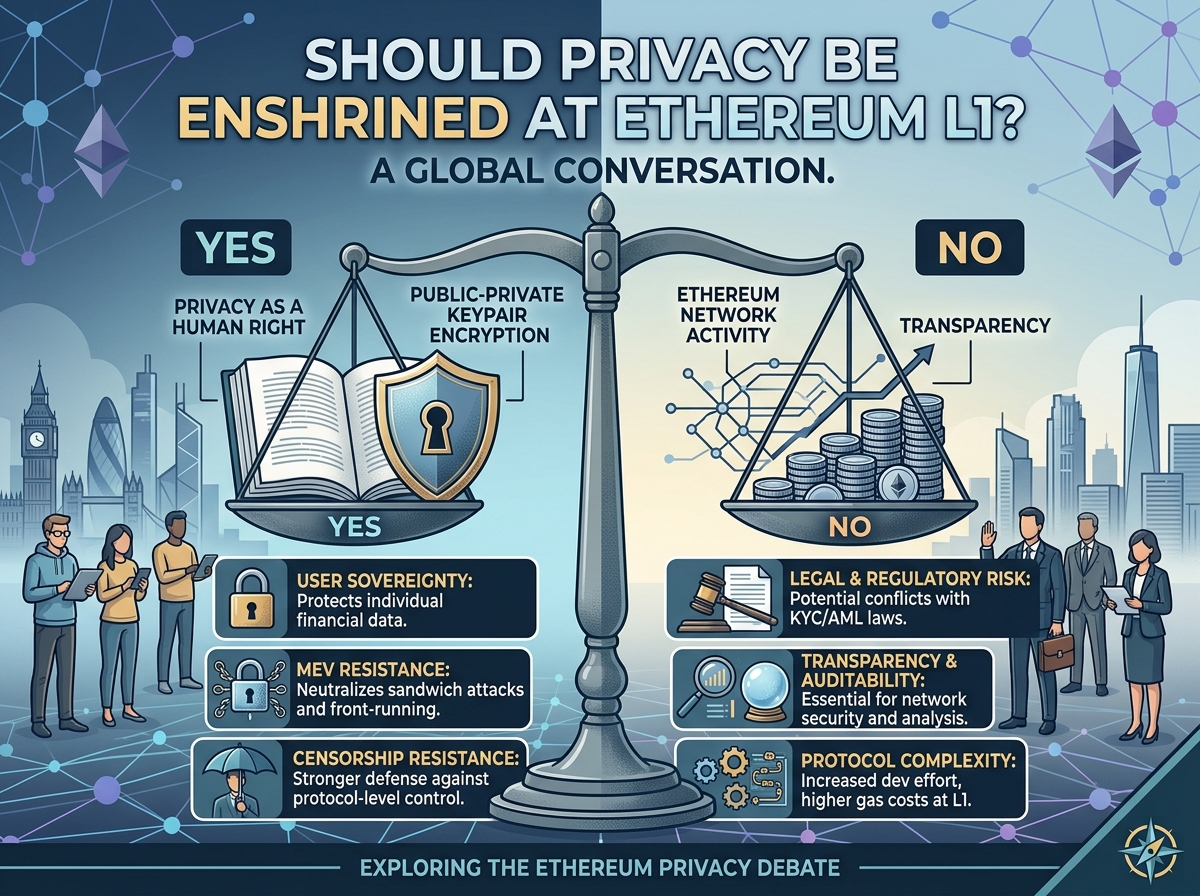
Ethereum is now treating privacy as a protocol-level concern, not an app-layer feature. The real debate is where L1 should guarantee privacy by default, and where L2s should keep specialized control.
Shuja Abrar · Blockchain Consultant & Engineer
- ethereum
- privacy
- l1
- l2
- zk
On this page
Ethereum’s privacy debate has changed. The question is no longer whether privacy matters on-chain; Ethereum’s own roadmap now treats it as a first-class network property, with work spanning private reads, private writes, and private proving. The real question is narrower and more useful: which parts of privacy belong in the base protocol, and which should remain in wallets, applications, and L2s?
That distinction matters because Ethereum L1 is still the system of record for shared settlement, liquidity, and DeFi. If the base layer remains transparent by default, then the rest of the stack inherits that transparency through RPC calls, mempool exposure, transaction ordering, address clustering, and identity leakage. If privacy is left entirely to optional tooling, it will remain fragile, fragmented, and easy to bypass. But if too much privacy is forced directly into L1, Ethereum risks making the protocol heavier, less legible, and slower to evolve.
The right answer is therefore not a simple yes or no. Privacy should be enshrined at Ethereum L1 where it creates a network-wide guarantee, but not as a single monolithic feature. Ethereum should standardize the privacy primitives that everyone depends on, while leaving room for specialized privacy systems above the base layer.
01What privacy means here
“Privacy” on Ethereum is not a single thing. The current roadmap breaks it into three related problems. Private reads mean users can query Ethereum without exposing which addresses, contracts, or data they are interested in. Private writes mean transactions can move through the network without revealing their contents or being selectively censored before inclusion. Private proving means users can prove identity, eligibility, or other facts without surrendering unnecessary personal data.
That framing is important because it shifts the debate away from the false binary of public versus private. Ethereum does not need to hide everything. It needs selective disclosure: the ability to reveal only what is necessary, when it is necessary, to the right counterparty. That is the logic behind privacy-preserving identity, confidential finance, and compliance-aware applications. It is also the logic behind why institutions care. A system that leaks less by default is easier to govern, audit, and secure than one that relies on everyone remembering to use privacy tools correctly.
So the real design question is not whether privacy belongs on Ethereum. It is whether privacy should be an optional feature productized by third parties, or a property that the protocol itself guarantees.
02Why L1 should carry privacy
The strongest argument for enshrining privacy at L1 is that the base layer defines the threat model for everyone else. Ethereum L1 is not just another app environment. It is the settlement layer that most of the ecosystem uses directly or indirectly. When the base layer leaks metadata, that leakage compounds. A wallet can hide a balance screen, but if the network can see the RPC queries, the mempool path, the transaction sequence, and the account linkages, the user is still exposed.
That is why the current Ethereum privacy roadmap emphasizes network-level defaults instead of opt-in patches. The roadmap explicitly says privacy is moving from an optional add-on to a structural property of the network. It also identifies private reads, private writes, and private proving as the core roadmap pillars. In other words, Ethereum’s own current direction is already toward enshrining privacy as part of protocol design rather than treating it as a niche application feature.
There is also a strong censorship-resistance argument. The Ethereum Foundation’s latest protocol priorities describe privacy as a protocol guarantee, with work aimed at native, trustless, censorship-resistant private transactions on L1. That language matters. A private transaction that can be delayed, filtered, or deanonymized before inclusion is not actually private in practice. This is also why encrypted mempools alone are not enough. The draft EIP for a universal encrypted mempool is explicit that its goal is to prevent malicious reordering and improve weak censorship resistance, not to provide lasting transaction confidentiality, since transactions are eventually revealed. That is an important distinction. Privacy at L1 cannot stop at hiding bytes in transit. It has to address inclusion, ordering, and disclosure together.
The case for L1 is therefore about universality. A base-layer privacy primitive can be used by a solo user, a wallet provider, a DeFi protocol, an institution, or another chain. It creates a common floor. It also reduces the burden on users to select a special-purpose privacy stack every time they transact. If privacy remains entirely optional, the ecosystem will keep leaking by default and fixing by exception.
03Why not everything belongs in L1
The counterargument is just as important. Ethereum L1 should remain maximally resilient, legible, and broadly neutral. Every feature added to the core protocol raises the cost of coordination and the risk of failure. Privacy tech is moving quickly, and not all of it needs consensus-level enshrinement to be useful. In practice, many privacy needs are application-specific. A consumer wallet, a treasury desk, a regulated institution, and a private DeFi venue do not need the same disclosure model or the same operational assumptions.
This is where Ethereum’s L1/L2 strategy becomes relevant. The Foundation’s current framing is that L1 should remain the resilient global hub for settlement, shared state, liquidity, and DeFi, while L2s provide differentiated features, customizations, and specialized control. That same logic applies to privacy. The L1 can provide the core guarantees that all users should inherit, while L2s can experiment with more opinionated designs: private execution, private state, confidential business logic, or application-specific compliance flows.
Ethereum’s own ecosystem documentation reflects that split. It points to privacy-focused L2s such as Aztec, which are designed for private execution and private state, alongside public Ethereum settlement. That is not a weakness in the roadmap. It is the right division of labor. Base-layer privacy should be the common substrate, not the only place privacy can exist.
There is a second reason not to over-centralize privacy in L1: privacy is not identical to secrecy. Many real-world users and institutions want selective disclosure, not total opacity. They need to prove eligibility, demonstrate reserves, or satisfy compliance rules without exposing unnecessary data. Some of those functions are better built as application layers or L2 services that can evolve faster than consensus can. If every privacy use case had to be hard-coded into L1, Ethereum would freeze the design space just when the ecosystem is finding better ways to balance confidentiality, verifiability, and compliance.
04What should be enshrined
The most defensible position is selective enshrinement. Ethereum should enshrine privacy where the property is foundational and cross-cutting: private access to chain data, private transaction transport and inclusion, and protocol-grade support for selective disclosure. It should not try to make L1 the entire privacy stack.
Concretely, that means L1 should standardize the interfaces and guarantees that make privacy usable everywhere else. Private reads should become reliable enough that querying the chain does not automatically broadcast a user’s interests to infrastructure providers. Private writes should be designed so censorship and metadata leakage are not the default outcome of using privacy tools. Private proving should make it possible to verify facts without turning every identity check into a data-extraction event.
That is consistent with the latest Ethereum Foundation guidance. The privacy cluster says privacy is not abstract research alone; it has to be organized, resourced, and deployed at scale. The protocol team is now treating privacy as one of its long-horizon research arcs, alongside state, zkEVM, fast finality, and post-quantum work. Read together, those statements imply a clear philosophy: privacy is part of Ethereum’s public goods layer, but implementation details should remain modular.
This is the healthiest outcome for the ecosystem. It gives developers a stable baseline, gives users a better default, and preserves room for innovation above the protocol. It also avoids a common trap in blockchain design: confusing “enshrined” with “all-encompassing.” Ethereum does not need to encode every privacy use case into consensus. It needs to make sure that privacy is no longer an afterthought, a plugin, or a luxury for power users.
05Practical takeaways
Ethereum should enshrine privacy at L1, but only for the primitives that create shared network guarantees. The base layer should protect access, inclusion, and selective disclosure; higher layers should remain free to specialize.
The practical test is simple: if a privacy property must hold for almost every user and every application, it belongs close to L1. If it is a specialized workflow, a business-specific policy, or a fast-moving product surface, it should live above L1.
That balance gives Ethereum the best chance of remaining both useful and credible: public by default where transparency matters, private by default where exposure is a liability, and modular enough to keep improving without breaking the chain.
Share
Link opens on iamshuja.dev · previews show the site card
Sources
5- 01The privacy roadmap for Ethereum (2026-08-24)ethereum.org
- 02EF Protocol: Current and Emerging Priorities (2026-09-07)blog.ethereum.org
- 03How L1 and L2s can build the strongest possible Ethereum (2026-03-23)blog.ethereum.org
- 04EIP-8105: Universal Enshrined Encrypted Mempool (2025-12-17)eips.ethereum.org
- 05Privacy Cluster Leadership Announcement (2025-10-01)blog.ethereum.org