PVARA licensing: will regulated crypto strengthen Pakistan’s FX position or leak it?
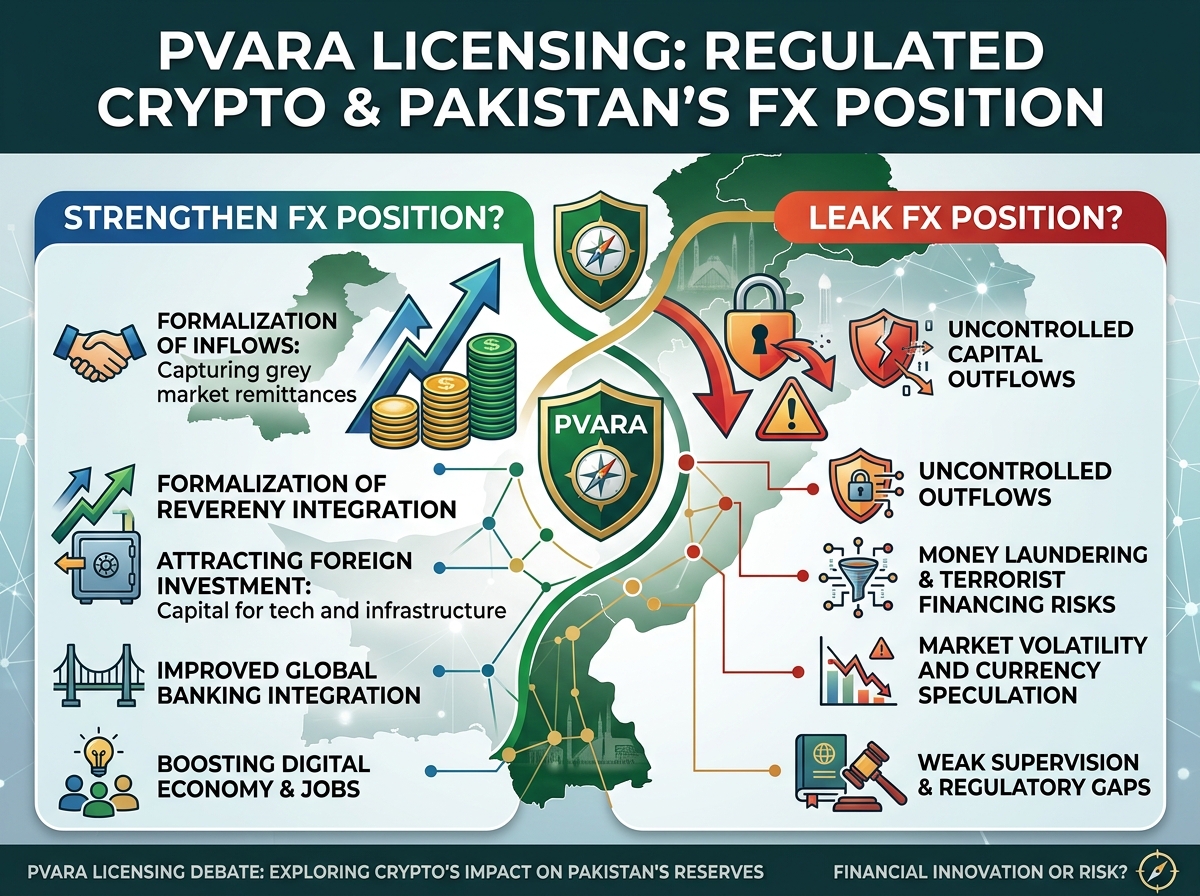
Pakistan’s new PVARA regime could formalize a large crypto market, but its FX impact depends on whether it channels flows into supervised rails or simply makes dollarization easier. The real test is compliance design, not token adoption.
Shuja Abrar · Blockchain Consultant & Engineer
- pakistan
- crypto
- fx
- regulation
- stablecoins
- compliance
On this page
Pakistan’s new virtual asset regime lands at a delicate point in its external accounts. The country has rebuilt foreign exchange buffers, but not to the point where policymakers can be casual about leakage. At the same time, a large, already-active crypto market has been pushed toward formal oversight. That makes PVARA’s licensing framework less a technology story than a balance-of-payments test: does it convert existing digital-value flows into supervised, taxable, onshore activity, or does it create a cleaner pipe into dollarized offshore markets?
01What PVARA actually changed
The key shift is that Pakistan now has a formal legal path for virtual asset businesses. PVARA says the Virtual Assets Act, 2026 is the primary legislation, and the Pakistan Virtual Asset Services Regulations and Activity Specific Regulations were notified on 21 August 2026. In other words, the regime is no longer just a policy signal or a draft framework; it is an operating licensing system.
The licensing sequence is important. An applicant first seeks a no-objection certificate, then incorporates a company in Pakistan, and only then applies for one or more license categories. The authority says it must decide a complete NOC application within 60 days, the NOC lasts three months, and it can be extended once for up to another three months. That sequencing matters because it tells us the state wants to screen participants before they enter the market, not merely register them after the fact.
The regulatory scope is also broad. The framework covers prudential requirements, governance, market conduct, technology, AML/CFT/CPF, and client asset protection. That is the right architecture if the policy goal is to move virtual assets out of the grey market and into an auditable perimeter. It is also a sign that PVARA is being set up as a financial integrity regulator, not a promotional office for crypto adoption.
Just as important, PVARA says a license does not equal state endorsement of any particular token. An exchange may list an asset if it is not restricted or prohibited and if it meets the exchange’s own standards, but notification to the authority does not amount to approval of the asset. That distinction will matter in practice. It prevents market participants from arguing that a license is a seal of safety or policy support for every token they choose to list.
02Where the FX upside could come from
The strongest argument for licensing is not that crypto magically creates foreign exchange. It is that an unregulated market already moves value across borders, and regulation can at least bring part of that movement into sight. If Pakistanis are already using stablecoins, offshore exchanges, or peer-to-peer rails to store value in a dollar proxy, the state is better off knowing who is doing it, through which entity, with what controls, and for what purpose.
That visibility can help in three ways. First, it can reduce illicit leakage. A supervised VASP can be required to run source-of-funds checks, wallet screening, transaction monitoring, and suspicious-activity reporting. Those are not glamorous tools, but they are the difference between a market that is observable and a market that is simply another parallel channel for moving out of rupees.
Second, licensing can create a bridge for compliant inward flows. Pakistan’s diaspora remittance base is a major support for external stability, and a regulated digital-asset layer could, in theory, offer faster settlement for some cross-border payments, especially for freelancers, exporters, and smaller service businesses. If the flow enters through a licensed onshore entity and settles into the domestic banking system, it strengthens the formal channels that the FX market actually depends on.
Third, the regime can improve domestic price discovery. If the same customers who used informal markets are now forced onto licensed venues, the regulator gets a better picture of spread behavior, arbitrage, and the scale of demand for dollar-like assets. That does not eliminate pressure on the rupee, but it turns hidden pressure into measurable pressure. For a central bank and finance ministry, that is still a gain.
Still, all of those benefits depend on design. A license alone does not produce FX resilience. The system has to require local incorporation, local governance, local reporting, and meaningful oversight of cross-border activity. If the market structure is just a Pakistani front-end with offshore liquidity and weak monitoring, the FX benefit will be thin.
03How regulated crypto can leak FX
The risk side is easy to miss because it often arrives wrapped in the language of innovation. The same stablecoin infrastructure that can make a payment faster can also make it easier to dollarize savings. For a household or firm that already worries about inflation or depreciation, a liquid token that tracks the dollar can become a better store of value than the rupee deposit account.
That matters in Pakistan because the exchange rate is still a policy variable, not a purely academic one. The SBP’s own data shows reserves have improved, but the buffer is still modest relative to external shocks. As of mid-October 2026, SBP reported liquid foreign exchange reserves of about $21.5 billion, with total reserves around $26.8 billion. That is a stronger position than in crisis periods, but not a cushion that can absorb unfettered capital leakage without consequences.
The IMF’s latest Pakistan assessment is aligned with that caution. It says exchange-rate flexibility should remain an important shock absorber and that further reserve accumulation, gradual liberalization of the foreign exchange regime, and deeper domestic financial markets would strengthen resilience. That is IMF language for a simple proposition: Pakistan still needs disciplined external management. It cannot afford a new retail channel that quietly drains rupee liquidity into offshore dollar assets.
The leak can happen in several ways. Residents can move savings from deposits into stablecoins. Traders can use local exchanges as on-ramps to offshore venues. Peer-to-peer markets can recreate a parallel rate outside the bank channel. And if licensed platforms make it easier to convert PKR into a dollar proxy without robust reporting, the result may be less transparency than the formal banking system already provides.
This is the real policy dilemma. PVARA can regulate a market, but it cannot wish away economic incentives. If the regulatory design is too permissive, the result is a legalized version of the hawala-style off-ramp, except with better user experience. If it is too restrictive, activity stays underground and the state loses visibility. The challenge is to force flows onto monitored rails without making those rails so burdensome that everyone goes back to the shadows.
04Pakistan’s baseline still decides the outcome
The biggest mistake would be to treat PVARA licensing as a substitute for macroeconomic repair. It is not. Pakistan’s external position is better than it was, and FY25 marked the first current-account surplus in 14 years, but that improvement came from a mix of remittances, import compression, and policy adjustment, not from crypto. Regulated virtual assets cannot replace exports, official inflows, or a credible exchange-rate framework.
That means the FX impact of PVARA will be marginal unless the broader policy stack also improves. If exports stagnate, if remittances weaken, or if the exchange rate becomes misaligned, any easy access to stablecoins will likely be used for hedging and capital protection, not for productive settlement. In that case, the licensing framework becomes a smoother leakage mechanism, even if it is technically compliant.
The more constructive reading is that PVARA gives the state a chance to capture activity that already exists. If the authority uses its licensing powers to impose strong custody rules, transparent listing standards, transaction monitoring, and clear restrictions on prohibited or high-risk flows, Pakistan can at least reduce the size of the blind spot. That would not solve the FX problem, but it would improve the quality of surveillance.
The practical test will be simple: does the system make virtual asset activity legible to the financial authorities, or does it merely make it more convenient? If it is legible, Pakistan gains tax visibility, compliance leverage, and a better read on capital movement. If it is just convenient, it leaks.
The answer, then, is not either/or. Regulated crypto can strengthen Pakistan’s FX position, but only indirectly and only under strict design. Without that discipline, the same framework could become a modernized leak channel. For policymakers, the priority should be to treat PVARA as an integrity regime first and a market-opening regime second. That is the only version that helps the rupee rather than quietly exporting pressure into dollarized digital assets.
Share
Link opens on iamshuja.dev · previews show the site card
Sources
5- 01Licensingpvara.gov.pk
- 02Regulationspvara.gov.pk
- 03IMF Staff Complete the 2026 Article IV Consultation and Reaches Staff-Level Agreement on the Fourth Review for the Extended Fund Facility and the Third Review for the Resilience and Sustainability Facility for Pakistan (2026-10-07)imf.org
- 04State Bank of Pakistan Economic Data Snapshot (2026-10-16)sbp.org.pk
- 05Balance of Payments, The State of Pakistan’s Economy, Half Year Report 2025-26sbp.org.pk