Prediction markets: derivatives or gambling, and is insider trading there even a crime?
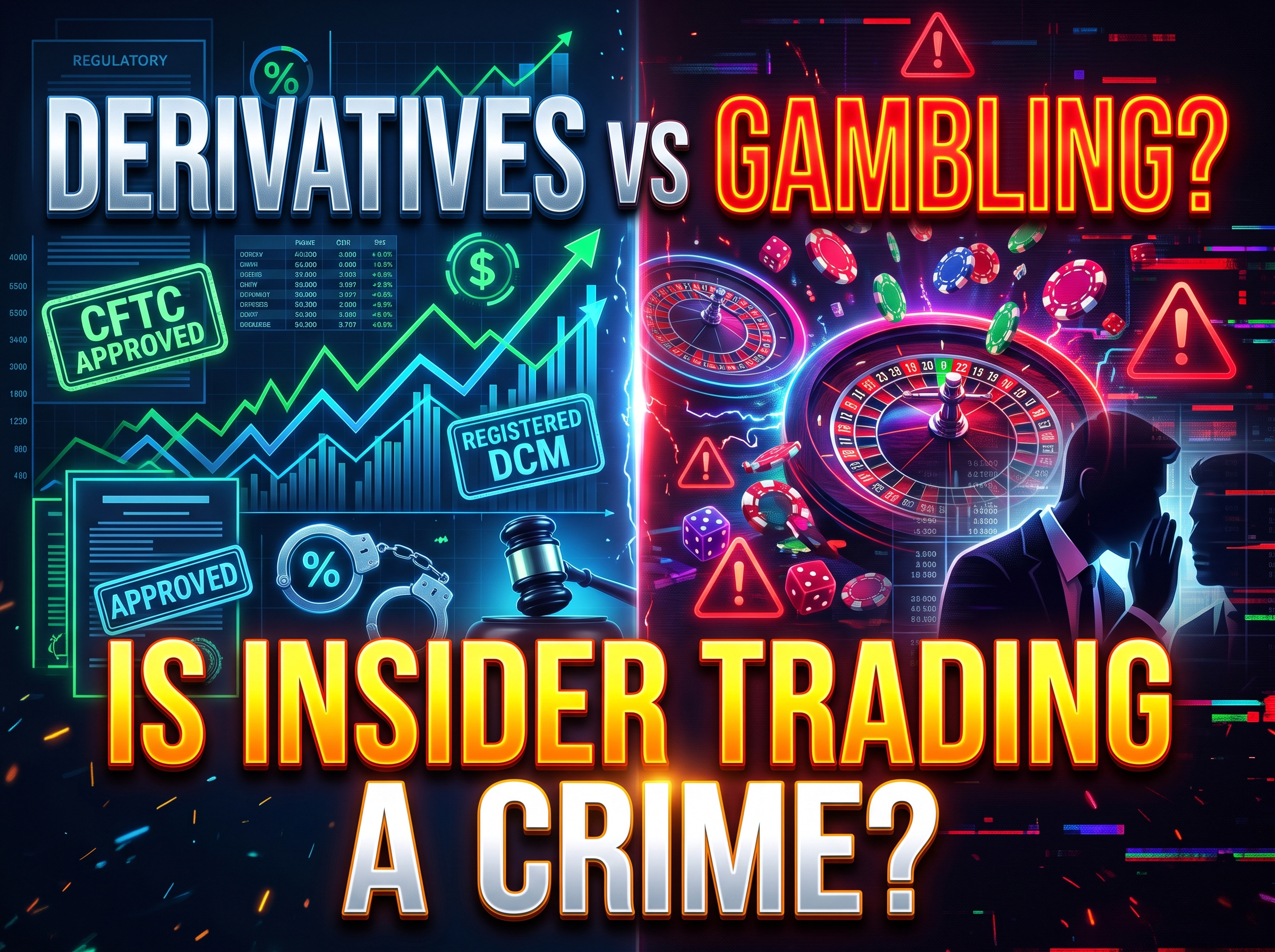
Prediction markets sit on a fault line between derivatives and gambling, and the line is moving fast. The bigger surprise is that insider trading rules still reach them—sometimes through commodities law, sometimes through wire fraud, and sometimes through both.
Shuja Abrar · Blockchain Consultant & Engineer
- prediction-markets
- derivatives
- gambling
- insider-trading
- cftc
- commodities
On this page
Prediction markets matter now because the fight over them is no longer theoretical. In 2026 the CFTC has been issuing fresh guidance, proposing new rules for event contracts, and suing states that try to block federally registered venues, while the Justice Department has already brought criminal charges over trading on classified information in prediction markets. That makes the core question practical, not academic: are these products derivatives, gambling, or some hybrid of both, and what happens when someone trades on nonpublic information?
01Derivatives with a gambling problem
The cleanest legal answer in the United States is that a prediction market is not defined by its vibe; it is defined by its structure and venue. The CFTC says event contracts are typically structured as swaps and are derivative contracts whose payoff depends on the outcome of an event. It also says these products have existed in U.S. regulated markets for more than two decades and can be used either to hedge risk or to speculate. That is why the regulatory home for a lawful prediction market is commodity derivatives law, not ordinary consumer gambling law.
But that does not mean every event contract is automatically welcome. Congress gave the CFTC authority to bar certain kinds of event contracts, and the agency’s current rulemaking focuses on contracts involving terrorism, assassination, war, gaming, or conduct unlawful under federal or state law. The CFTC’s own language is telling: prediction markets can be legitimate derivatives, but only if the contract design survives a public-interest review and fits within the Commodity Exchange Act. In other words, the legal system does not ask whether people are “betting” in the colloquial sense. It asks whether the contract is a permissible derivative product on a federally regulated market.
That distinction matters because the same mechanism can feel very different depending on what is being traded. A contract referencing a macroeconomic release, snowfall, or corporate earnings looks close to conventional derivatives logic. A contract that tracks a sports result, a celebrity appearance, or a political outcome starts to resemble wagering to many state regulators and consumer advocates. The deeper the contract is tied to an activity Congress singled out as problematic, the more likely it is to face the label of gambling even if the venue insists it is trading a financial instrument.
02Why the legal line keeps moving
The current dispute is not just about definitions; it is about jurisdiction. The CFTC says prediction markets on registered designated contract markets fall under its exclusive federal authority, and in November 2026 it went to court against Arkansas to stop state efforts to shut down event-contract trading. That federal-versus-state conflict is the practical reason these markets remain unstable even when the venue is registered and the contracts are exchange-traded.
The agency is also trying to regularize the space rather than freeze it. In March 2026 it issued an advance notice of proposed rulemaking on prediction markets, and in June it followed with a notice of proposed rulemaking aimed at event contracts involving enumerated activities. The message is not that prediction markets are unregulated; it is that the CFTC wants a clearer framework for deciding which contracts should be permitted, how they should be reviewed, and when they are contrary to the public interest.
That leaves the market in a narrow corridor. On one side, proponents argue that prediction markets are useful information markets: they aggregate dispersed knowledge, produce prices that can be informative, and may help users hedge exposures that traditional markets do not cover well. On the other side, critics see products that look and feel like sports books or political bets dressed up in derivatives language. Both views have some force. A serious analysis has to admit that prediction markets can serve financial and informational functions while still being close enough to gambling in some cases that regulators will keep scrutinizing them.
03Insider trading is still a crime
The short answer is yes, insider trading can absolutely be a crime in prediction markets. The more precise answer is that it is not usually called “securities insider trading,” because these are not securities markets. But the same underlying conduct can still be prosecuted under commodities-fraud, anti-manipulation, wire-fraud, and related statutes.
The CFTC made that explicit in February 2026 when its Enforcement Division issued an advisory after two cases involving misuse of nonpublic information and fraud on Kalshi, a CFTC-designated contract market. In one case, a political candidate appeared to trade on his own candidacy. In another, a trader with an employment relationship to the subject of the contract was believed to have used material nonpublic information. The CFTC said the first fact pattern potentially violated the anti-fraud provisions of the Commodity Exchange Act and Rule 180.1, and the second potentially violated rules against misappropriating confidential information in breach of a duty of trust and confidence. The agency also said it has full authority to police illegal trading practices on any designated contract market, including prediction markets.
That is the key point for compliance teams: on a regulated prediction market, insider trading is not a loophole just because the underlying asset is an event instead of a stock. If a trader has direct or indirect influence over the outcome, or if the trader learns the information because of a job, contract, or fiduciary duty, the CFTC’s anti-fraud framework can reach the conduct. Exchange rules can also be even stricter than the statute; Kalshi’s own disciplinary actions in 2025 and 2026 show that venues may suspend users, claw back profits, and impose long-term bans before a regulator even finishes its case.
The Department of Justice has now gone further. In April 2026 it charged a U.S. Army soldier with using classified information about a military operation to trade on Polymarket. The indictment included charges for commodities fraud, wire fraud, unlawful use of confidential government information, theft of nonpublic government information, and an unlawful monetary transaction. DOJ officials described the conduct as clear insider trading and said federal laws protecting national-security information apply even in prediction markets. That case matters because it shows the government does not need a stock exchange, issuer, or securities filing regime to treat misuse of confidential information as criminal. The legal theory can shift, but the result is the same: if you monetize privileged information to influence an event-market position, you may be committing a federal crime.
04What compliance teams should do
For operators, the safest mental model is to treat prediction markets as regulated derivatives venues that happen to be unusually exposed to public-policy, political, and informational risks. That means building surveillance for self-trading, coordinated trading, wash activity, and suspicious wins tied to insiders. It means screening for users who can influence the referenced event, whether through employment, office, vendor access, or public office itself. It also means documenting settlement mechanics with unusual care, because the more ambiguous the contract, the easier it is for a regulator to say the market is manipulative or contrary to the public interest.
For users, the important takeaway is simpler. A prediction market is not a legal free-for-all just because the contract settles on an event instead of a share price. If the platform is CFTC-regulated, anti-fraud and anti-manipulation law applies. If the information came from a duty-bound relationship, a classified briefing, a nonpublic work role, or any other source you were not allowed to exploit for personal gain, you should assume the law may treat it as insider trading in substance even if the market is not a securities market.
The most accurate answer to the title question is therefore this: prediction markets can be derivatives, and some are plainly regulated as derivatives today. But some contracts are vulnerable to gambling-style objections, state-law challenges, or outright prohibition. And yes, insider trading there can still be a crime, because the law reaches the misuse of confidential information even when the thing being traded is a probability rather than a stock.
Share
Link opens on iamshuja.dev · previews show the site card
Sources
7- 01CFTC Enforcement Division Issues Prediction Markets Advisory (2026-02-25)cftc.gov
- 02CFTC Staff Issues Prediction Markets Advisory (2026-03-12)cftc.gov
- 03CFTC Seeks Public Comment on Notice of Proposed Rulemaking Concerning Event Contracts Involving Enumerated Activities (2026-06-10)cftc.gov
- 04CFTC Files Lawsuit Against Arkansas as the Agency Defends its Federal Jurisdiction Over Prediction Markets (2026-11-13)cftc.gov
- 05U.S. Soldier Charged With Using Classified Information To Profit From Prediction Market Bets (2026-04-23)justice.gov
- 06Understanding Prediction Markets and Event Contractscftc.gov
- 07Contracts & Productscftc.gov