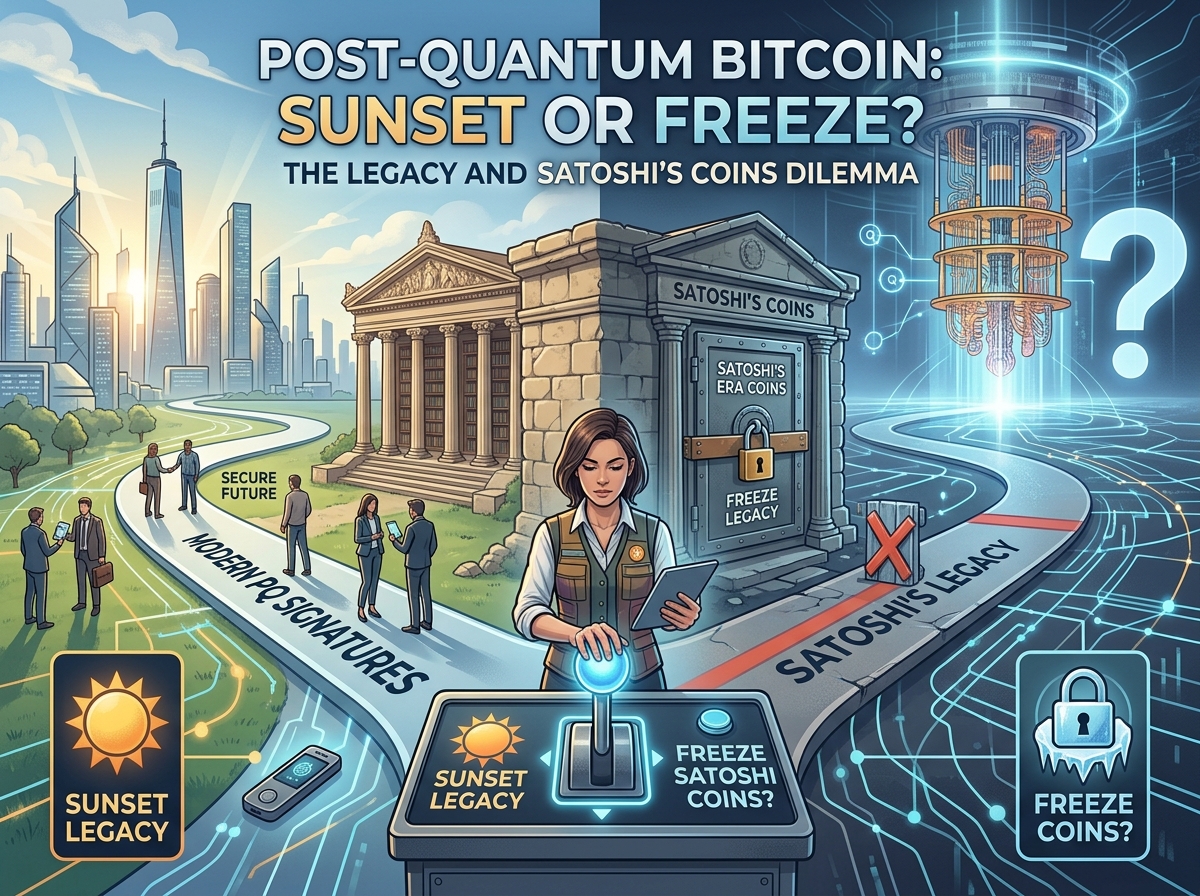
Post-quantum: should Bitcoin sunset legacy signatures and effectively freeze Satoshi-era coins?
Bitcoin is now close enough to post-quantum migration that policy choices matter: should the network preserve old coins at all costs, or force a deadline and risk freezing dormant wealth? The answer depends less on cryptography than on Bitcoin’s tolerance for protocol-level confiscation.
Shuja Abrar · Blockchain Consultant & Engineer
- bitcoin
- quantum
- cryptography
- consensus
- security
On this page
01Why this debate matters now
The post-quantum question stopped being theoretical once NIST finalized its first post-quantum digital signature standards on August 13, 2024, and kept extending the program into 2026. At the same time, Bitcoin developers and researchers have moved from abstract warnings to concrete migration ideas, including a 2026 draft proposal for a post-quantum signature path and a sunset for legacy ECDSA and Schnorr spends. That changes the conversation. The question is no longer whether Bitcoin will need quantum-resistant signatures. It is whether the network should force the issue by making old signatures unusable, even if that means some long-dormant coins become effectively stranded.
That is not a cosmetic upgrade. Bitcoin’s current security model still depends on classical public-key cryptography. Legacy outputs use ECDSA, Taproot uses Schnorr, and both sit in the class of schemes a sufficiently capable quantum computer could undermine. So the real policy choice is between two risks: leaving vulnerable coins spendable for too long, or invalidating some existing coins to protect the network before a crisis arrives.
02What a sunset would do
The draft BIP 361 proposal, assigned on February 11, 2026, is explicit about the mechanism. It follows the introduction of a post-quantum output type and then stages in a pre-announced sunset of legacy signatures. Phase A would stop new sends to quantum-vulnerable address types. Phase B would later restrict ECDSA and Schnorr spends through a quantum-safe rescue protocol, with a five-year flag day after activation. In other words, it is not just a new address format. It is a consensus-level deadline.
That deadline is what makes the proposal powerful and controversial. It turns migration into a hard incentive. If users, custodians, exchanges, and wallet vendors do nothing, their coins become harder or impossible to move. The proposal’s authors argue that this is the only credible way to beat coordination failure at Bitcoin scale. They also point to a striking data point in the draft itself: as of March 1, 2026, more than 34% of all bitcoin had already revealed a public key on-chain. In their view, that is too much exposed value to leave hanging while quantum hardware improves.
The technical intuition is straightforward. A quantum attacker does not need every coin. It only needs a large population of targets whose public keys are already known or can be revealed before the attack lands. Bitcoin’s design favors long-lived keys, reuse is common in bad operational setups, and some early outputs were created in forms that exposed public keys directly. From that vantage point, a sunset looks less like confiscation and more like routine hardening after a long warning period.
03The case for moving fast
The strongest argument for a sunset is that Bitcoin upgrades slowly, while cryptographic risk can move quickly once it becomes real. The ecosystem has a long history of coordination delays. Hardware wallets need firmware updates. Custodians need new approval flows. Exchanges need deposit and withdrawal logic. Multisig providers need new policies. Cold-storage operators need migration tools that are simple enough for non-specialists to use without making mistakes. If Bitcoin waits until a cryptographically relevant quantum computer is widely believed to exist, it may already be too late to coordinate a clean response.
There is also a fairness argument. If legacy signatures remain valid forever, the first people to face quantum-capable attackers will be those who happen to leave exposed public keys behind. That creates a race between adversaries and users. A sunset, by contrast, converts a probabilistic attack into a scheduled migration. Everyone gets the same notice. Everyone faces the same timeline. Everyone knows the rules.
That is why the proposal frames the issue as defensive rather than punitive. It wants to reduce the attack surface with each new UTXO, force the market to adopt quantum-safe addresses, and give institutions a concrete compliance date instead of an open-ended “someday.” In a world where NIST is already telling organizations to start transitioning now, that argument has real force. Bitcoin should not be the last critical system to start planning for a known cryptographic transition.
04The case against freezing
The problem is that “move fast” and “freeze old coins” are not the same thing. A sunset can protect the network and still be deeply coercive. If a coin has been dormant for fifteen years, is the owner absent, dead, lost, imprisoned, technically unsophisticated, or simply waiting for better tooling? The protocol cannot know. A blanket cutoff would not distinguish between abandoned coins and coins whose owners have valid reasons not to move on the committee’s schedule.
That is the central moral hazard. A quantum sunset would not merely deprioritize legacy signatures. It would reclassify some outstanding property claims as permanently unspendable. That is a very different event from encouraging migration. It resembles protocol-sanctioned confiscation, even if the stated reason is defensive. Once that precedent exists, future coalitions may be tempted to use “security” as justification for other forms of forced reallocation.
The economic risk is also nontrivial. Bitcoin’s legitimacy rests on predictable rules. People can accept volatility, but they are much less comfortable with a rule that says long-held coins may become inaccessible because the network decided the old cryptography had expired. The more valuable the dormant balance, the more politically explosive the cutoff becomes. Satoshi-era coins are especially sensitive because they are culturally important, not just economically large. Freezing them would not feel like an ordinary maintenance upgrade. It would feel like rewriting the social contract.
There is also a technical concern: a sunset does not automatically solve every edge case. Rescue protocols may work for some wallet architectures and not others. They may help users with deterministic HD wallets and hardened derivation paths, but they may not cleanly cover all old multisig arrangements, dead-man setups, paper wallets, institutional vaults, or one-off scripts. The proposal itself acknowledges that the design space is still moving. That is exactly why a hard deadline is dangerous: it pushes the network to make irreversible policy choices before the tooling is mature.
05A safer Bitcoin path
Bitcoin should absolutely prepare for post-quantum signatures. It should not, however, rush into a hard sunset that effectively freezes Satoshi-era coins before the ecosystem has a mature migration path, broad wallet support, and a better empirical sense of the quantum timeline. The more defensible route is to make the post-quantum path normal first, optional second, and mandatory only much later, if ever.
That means prioritizing a real post-quantum output type, not just a debate about deadline policy. It means giving wallets a default path that does not expose public keys unnecessarily. It means making address reuse embarrassing and visible. It means teaching custodians to rotate funds into quantum-resistant formats well before there is any panic. It also means considering policy-layer discouragement before consensus-layer invalidation. Bitcoin can make legacy outputs progressively less attractive without immediately making them impossible to spend.
If the network eventually does reach the point where a quantum computer can break secp256k1 at scale, then a more aggressive policy may become unavoidable. At that point, the question would no longer be whether to impose friction, but how to protect users while preserving as much spendability as possible. Even then, the best answer would probably be narrower than a blanket freeze. A recovery design with a long notice period, clear exceptions, and explicit treatment of ancient coins would be preferable to an abrupt deadline.
The practical takeaway is simple. Bitcoin should build quantum-safe spending paths now, default new activity toward them, and treat legacy signatures as a shrinking legacy surface, not as something to be suddenly erased from history. A hard sunset may someday be justified, but only if the threat is real, the migration tooling is ubiquitous, and the social costs have been openly accepted. Until then, freezing Satoshi-era coins is a solution to a future problem that could easily create a present-day legitimacy problem.
Share
Link opens on iamshuja.dev · previews show the site card