PHP2Shell: Critical PHP Vulnerabilities Expose Millions of Websites to Remote Code Execution
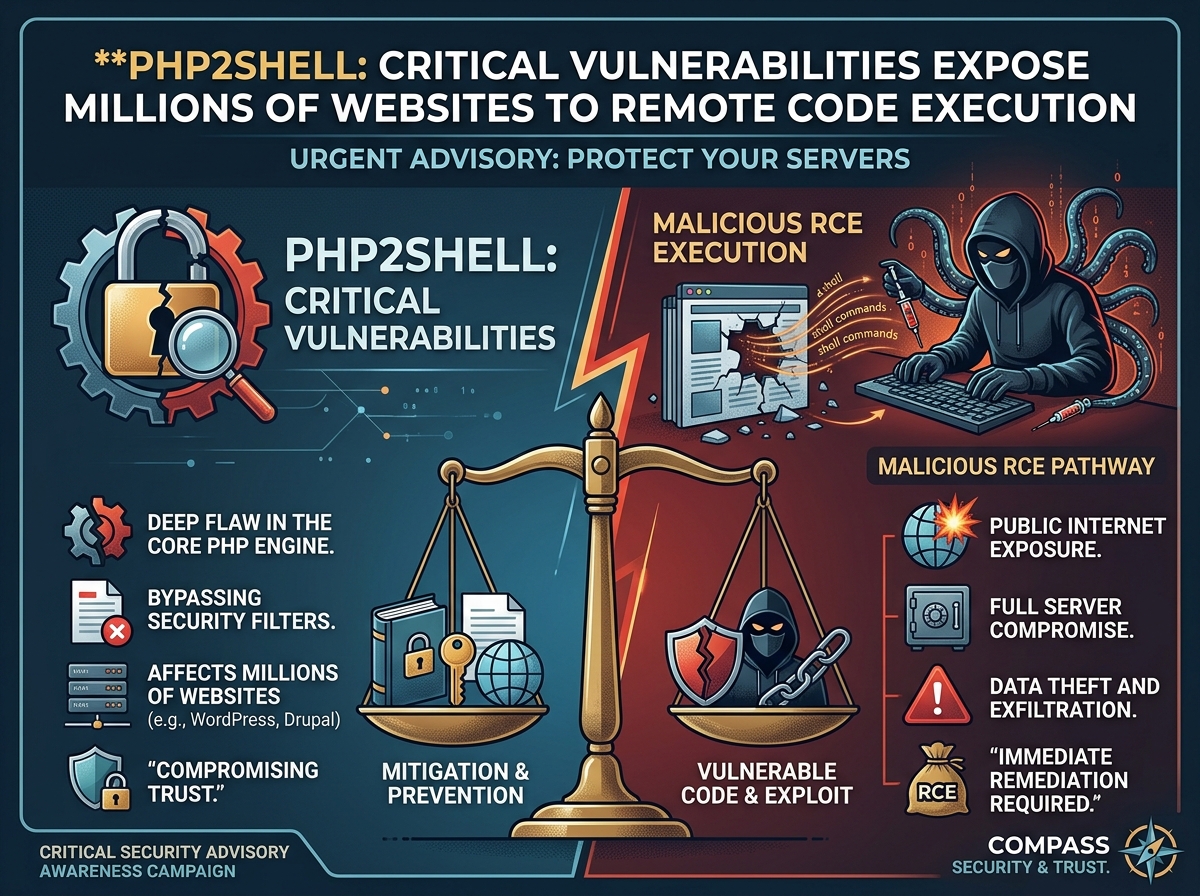
PHP2Shell is a runtime-level emergency: two critical PHP flaws can yield unauthenticated RCE before application code runs. The real lesson is operational, not theoretical — inventory every PHP runtime, patch immediately, and do not mistake mitigations for safety.
Shuja Abrar · Blockchain Consultant & Engineer
- php
- vulnerability
- rce
- websecurity
- incidentresponse
On this page
Emergency PHP patches on October 21 landed with unusually little room for delay. The issue is not a vulnerable plugin, framework, or application library that a site owner can swap out independently; it is the PHP runtime itself. That means the attack surface spans a large chunk of the web stack at once, from traditional Apache deployments to PHP-FPM, CGI-based installs, FrankenPHP, and LiteSpeed. When the language engine has a remote code execution flaw, the usual advice to harden an app or review input validation only goes so far.
That is why the two flaws now collectively known as PHP2Shell matter so much. They are critical, unauthenticated remote code execution bugs in core PHP, and the official guidance is blunt: update immediately. For defenders, the uncomfortable part is that the dangerous path can begin before any application code runs. If you are still thinking in terms of application-layer defenses only, you are already behind the threat model.
01What PHP2Shell actually is
The PHP project shipped fixed releases for 8.5.12, 8.4.27, 8.3.36, and 8.2.35 to address CVE-2026-109618 and CVE-2026-109619. The project said all PHP installations serving web requests should be treated as affected, with highest risk in Apache mod_php because an unauthenticated request can trigger exploitation before application code starts.
The first flaw, CVE-2026-109618, is an out-of-memory corruption issue. In certain request-processing paths, PHP can hit memory exhaustion while internal request state is only partially initialized. If the runtime exits that path incorrectly, request cleanup can later treat invalid state as if it were valid. That creates a path to code execution with the web worker’s privileges.
The second flaw, CVE-2026-109619, is a stale global state problem. Request-owned state can survive after its backing memory has been freed, and a later request handled by the same worker can consume that stale data before normal initialization has reset it. The practical implication is simple: a request that should have been isolated can leak across the boundary into another request on the same worker.
These are not theoretical corner cases in an obscure configuration. The official advisory and GitHub security notes both treat the impact as unauthenticated remote code execution, memory disclosure, and high-severity compromise potential. The CVSS v4 base score for each issue is 9.2.
02Why the exposure is broad
The reason this story escalated so quickly is that PHP remains one of the default plumbing layers of the web. Cloudflare notes that PHP powers nearly 70 percent of websites, which means the blast radius is enormous even if the vulnerable code is buried in the runtime rather than in a popular app. That does not mean 70 percent of the internet is instantly compromised. It does mean that a flaw in the interpreter itself touches a very large installed base, including legacy deployments that are often slow to upgrade.
There is also a structural problem: many teams do not have a complete inventory of where PHP runs. A company may know its public site is on PHP, but miss internal apps, admin consoles, vendor portals, partner-facing services, or embedded products that ship with a bundled PHP runtime. The NCSC-NL operational repository created after disclosure lists examples such as commercial appliances and cloud services under investigation, which is a reminder that exposure extends far beyond a single website.
The deployment model matters too. PHP-FPM, mod_php, CGI, and embedded runtimes do not all fail in the same way, and the official guidance is careful about that. mod_php is the most worrying because the exploit can happen before the application code has a chance to reject a request. FPM is not immune, but the exploit conditions differ. That distinction matters for incident response: a team that assumes only its app code can trigger compromise may miss the real entry point entirely.
03Why patching cannot wait
The PHP project was clear that there are no complete mitigations. That is an important sentence, because it prevents a common mistake: treating a WAF rule, a reverse-proxy filter, or a request-size limit as a substitute for the patch. Those controls can reduce exposure to some attack paths, but they do not make an installation safe.
This is especially true because the exploit lives in runtime behavior, not just in a recognizable request pattern. Cloudflare said it deployed protections ahead of public disclosure and still observed attack traffic and payload mutation attempts. That is what active exploitation pressure looks like when defenders start building virtual patches before the rest of the market even sees the advisory. It also shows why signature-only protection is brittle against motivated attackers.
The remediation guidance in the PHP advisories reflects that reality. For the OOM corruption issue, the longjmp-based out-of-memory handling was replaced with safer behavior that avoids leaving invalid state for shutdown to process. For the stale-state issue, the guidance includes reducing worker reuse where feasible and eliminating avoidable fatal errors, but the project still treats updating as the only complete fix. In plain English: reduce risk where you can, but do not mistake risk reduction for resolution.
That also means patch sequencing matters. If you run your own PHP builds, you need to upgrade the runtime itself, not just the application image or package set around it. If you depend on a distro or LTS vendor, you need to verify which backports they have shipped and whether the patched package is actually on the host. And if you run a fleet with multiple PHP versions, you need to assume the oldest supported branch in your environment is the one most likely to be overlooked.
04How defenders should respond
The first priority is simple: inventory every PHP runtime, not just every PHP application. That includes public web servers, staging environments exposed to the internet, admin panels, container images, appliance firmware, and any serverless or managed service where PHP is embedded. If you cannot say where PHP is running, you cannot know where the risk is.
The second priority is to patch to PHP 8.5.12, 8.4.27, 8.3.36, or 8.2.35, or to the equivalent backported package from your distribution or vendor. For organizations still pinned to 8.1 or older, the PHP project is no longer providing upstream support, so you need to rely on a vendor backport or make an upgrade plan now rather than later.
The third priority is to treat web traffic to PHP endpoints as potentially hostile until the patch lands everywhere. If you have a front door that can reject multipart traffic, overly large uploads, or requests that are not needed for a given service, that is worth doing. If you can reduce worker reuse, that may reduce reliability for the attacker. If you can disable features such as session upload progress where they are not needed, do it. But none of those actions replaces the runtime update.
The fourth priority is operational. Check for signs that PHP workers have been restarting unexpectedly, that fatal errors are appearing in places they did not before, or that unusual request patterns are showing up in your edge logs. Because the exploit can run before application code, an application log review alone is not enough. You need to look at the web server, the PHP runtime, and any reverse proxy or WAF logs that can show request shape and response behavior.
The practical takeaway is stark. PHP2Shell is not just another CVE pair to track in a backlog. It is a runtime-level RCE issue with broad reach, immediate patch guidance, and no complete substitute for upgrading. If PHP exists anywhere in your estate, the right response is to find it, patch it, and verify the fix everywhere it runs.
Share
Link opens on iamshuja.dev · previews show the site card
Sources
5- 01PHP security advisory: Critical remote code execution vulnerabilities, update now (2026-10-21)php.net
- 02RCE via OOM corruption · Advisory · php/php-src (2026-10-21)github.com
- 03RCE via stale global state · Advisory · php/php-src (2026-10-21)github.com
- 04Cloudflare deploys protections against php2shell vulnerability (2026-10-21)blog.cloudflare.com
- 05php2shell vulnerabilities (CVE-2026-109618, CVE-2026-109619) (2026-10-21)github.com