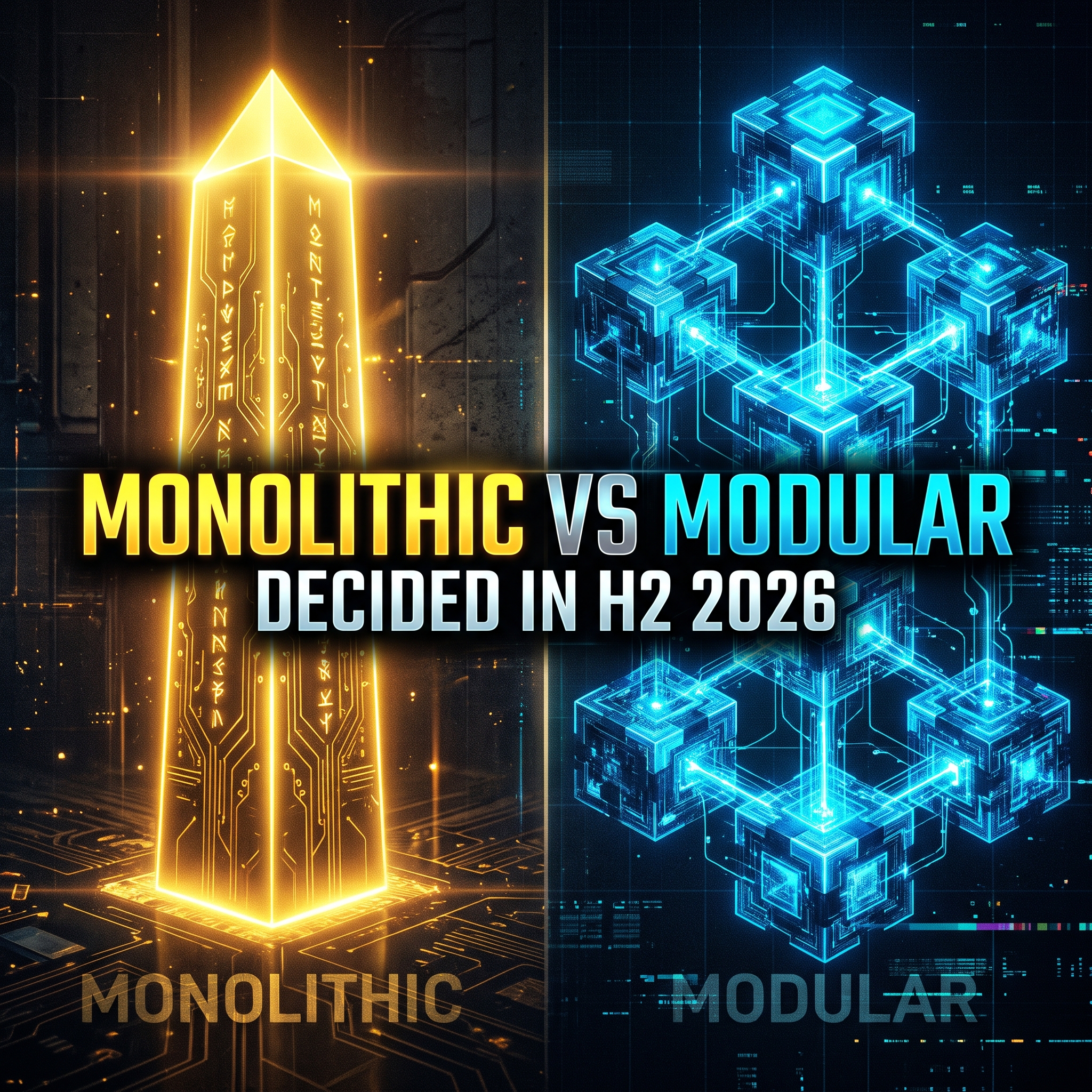
Monolithic vs modular, decided in H2 2026
By H2 2026, monolithic vs modular is no longer a theory fight. Ethereum, Solana, and Celestia now make the tradeoff concrete: speed and composability on one side, specialized throughput and modular scaling on the other.
Shuja Abrar · Blockchain Consultant & Engineer
- blockchain
- modular
- monolithic
- ethereum
- solana
- celestia
On this page
The monolithic-versus-modular debate was once framed as a philosophy contest. In H2 2026 it looks more like an engineering budget decision. The networks and stacks that matter most are no longer arguing about abstractions; they are shipping concrete changes that make their tradeoffs obvious. Ethereum is pushing execution and data availability together rather than pretending they are independent. Solana is proving that a monolithic design can still drive sub-second finality and much larger blocks. Celestia is showing that data availability can be specialized, isolated, and scaled far beyond what a general-purpose base layer can comfortably absorb.
The result is not a clean winner. It is a clearer market. If you are building a payments rail, a trading venue, a consumer app with tight state coupling, or a product where every millisecond matters, monolithic design still has a strong claim. If you are building a rollup, an appchain, a specialized execution environment, or anything whose main bottleneck is data publication rather than local state coherence, modular stacks are now the more natural fit. The decision has moved from ideology to requirements.
01What the debate became
At a technical level, the distinction is simple. A monolithic blockchain tries to do execution, settlement, consensus, and data availability in one base layer. A modular stack separates those functions and lets specialized layers do one job well. That split is attractive because it lets systems optimize for different bottlenecks independently. It is also messy because every split creates new operational boundaries, new trust assumptions, and new failure modes.
What changed in 2026 is that both models stopped pretending to be universal. Ethereum’s roadmap now explicitly treats scaling the L1 and scaling blobs as intertwined work. Solana’s upgrade path has focused on throughput, latency, and finality inside a single integrated architecture. Celestia’s messaging has become even more direct: it is a modular data availability network, not a general-purpose execution layer. The ecosystem has effectively sorted itself into layers.
That matters because the old debate assumed there would be one architecture that would dominate everything from consumer apps to institutional markets. H2 2026 says otherwise. Architecture is now workload-specific. The question is not which model is superior in the abstract. The question is which constraints you are trying to minimize.
02Why monolithic still wins
Monolithic chains still have a powerful advantage: they minimize coordination. If execution, consensus, and data availability all live in the same system, then the chain can offer a single, tightly integrated state machine. That reduces cross-layer latency, simplifies application assumptions, and keeps composability in one place. For many apps, especially those that depend on atomic state updates and low-latency ordering, that simplicity is worth a lot.
Solana is the clearest current example. Its 2026 upgrades show a chain that is not retreating from the monolithic model, but doubling down on it. The network now advertises 200 millisecond slot times, 100 million compute-unit blocks, larger 4096-byte transactions, and Alpenglow finality targeted at roughly 150 milliseconds. That is not just incremental tuning. It is a statement that a single high-performance base layer can still compete on user experience where speed and determinism are core product features.
That matters for onchain markets, instant payments, gaming, social apps, and any system where the user perceives delay as failure. A monolithic chain gives developers a single execution environment and a single liquidity surface. It avoids the fragmentation that comes from splitting apps across multiple rollups or app-specific chains. It also makes the failure model easier to reason about: the chain either keeps up or it does not.
The cost is obvious. A monolithic design has to carry more of the stack inside one protocol boundary, which raises hardware pressure, client complexity, and the risk that one layer’s bottleneck becomes everyone’s bottleneck. Solana has shown that those tradeoffs can be managed, but not eliminated. Monolithic systems can be fast, but they are not free.
03Why modular won
Modular architectures won a different contest: the contest over specialization. If execution is separated from settlement and data availability, each layer can scale on its own terms. That is especially compelling when the main constraint is not consensus speed but data throughput. Rollups do not need every node in the ecosystem to execute every transaction. They need a secure place to publish data and a credible way to prove or verify state transitions.
Ethereum’s current roadmap reflects exactly that reality. Its documentation now frames blobs as the cheap data path for rollups, and the roadmap points toward higher data throughput through PeerDAS and further blob scaling. The default gas limit was raised to 60 million after Fusaka, and the roadmap continues to treat L1 execution increases and blob growth as a linked program rather than separate fights. The important point is not the exact number. It is that Ethereum is scaling the base layer while preserving the idea that most application activity should happen above it.
Celestia makes the modular thesis even more explicit. Its documentation describes a network that orders blobs and keeps them available while execution and settlement live above the base layer. Light nodes can verify availability through sampling without downloading whole blocks, which is the whole point of data availability specialization. In October 2026, Celestia said its Fibre system sustained 3.07 terabits per second in an end-to-end benchmark across 120 validators. That is a dramatic proof that a narrow layer, optimized for data availability, can scale at a level a general-purpose chain would struggle to match.
For builders, the attraction is control. Modular systems let teams pick their own execution environment, choose their own upgrade cadence, and tailor economics to the application. If you are launching an exchange, a sovereign appchain, or a product whose workload grows much faster than the base chain can reasonably absorb, modularity gives you room to expand without forcing everyone else to pay for your demand.
04The real choice in 2026
The real decision is not monolithic versus modular. It is where you want complexity to live.
Choose a monolithic chain when your application needs a shared state surface, low-latency confirmation, and tight composability more than it needs bespoke execution rules. That is the better fit for orderflow-heavy products, consumer apps that depend on immediate feedback, and systems where the cost of cross-domain coordination is greater than the cost of running on a heavier base layer.
Choose a modular stack when your application’s bottleneck is data, when you want to isolate execution from settlement, or when you need to scale independently from the rest of the ecosystem. That is the better fit for high-throughput financial systems, appchains, and infrastructure that will outgrow a single general-purpose chain.
The practical takeaway is that 2026 did not produce a winner that replaced the other side. It produced a division of labor. Monolithic chains are winning where latency and coherence matter most. Modular stacks are winning where throughput, specialization, and independent scaling matter most. Most serious systems will end up hybrid, even if they are marketed as one or the other.
If you are designing for the next wave of digital asset infrastructure, the safest answer is to stop asking which model is more elegant. Ask which bottleneck is binding today, which one will bind in 12 months, and which layer you want to own when usage scales. In H2 2026, that is the question that decides architecture.
Share
Link opens on iamshuja.dev · previews show the site card
Sources
7- 01Protocol Priorities Update for 2026 | Ethereum Foundation Blog (2026-02-18)blog.ethereum.org
- 02Ethereum roadmap | ethereum.orgethereum.org
- 03Danksharding | ethereum.orgethereum.org
- 04Solana Network Upgrades | Solana Mediasolana.com
- 05Alpenglow | Solana Mediasolana.com
- 06Celestia's data availability layerdocs.celestia.org
- 07Celestia Fibre Hits 3 Tb/s (2026-10-01)blog.celestia.org