How Top Enterprises & Institutions Use Crypto Data APIs
Crypto data APIs have become core infrastructure for valuation, surveillance, and compliance. The firms that use them best turn fragmented on-chain and market data into auditable decisions.
Shuja Abrar · Blockchain Consultant & Engineer
- crypto
- api
- enterprises
- compliance
- market-data
On this page
Crypto data APIs matter because institutions do not use digital assets as a hobbyist market anymore; they use them as production infrastructure. Pricing, collateral management, treasury, surveillance, and compliance all depend on data that is normalized, auditable, and reproducible. In 2026 that requirement is sharper, not softer: Chainalysis said its 2026 crime report found record illicit crypto activity in 2025, driven heavily by sanctioned-entity exposure, while both Chainalysis and TRM describe compliance programs that are becoming more demanding rather than less. The same rails that move value instantly also create a permanent need to explain where that value came from, what it is worth, and whether it is safe to touch.
01The data problem institutions solve
A serious crypto desk never asks for “the price” in the singular. It asks for a market-specific, venue-specific, and methodologically defensible series that can survive a model review, a committee meeting, and an audit. Spot trades, quotes, order books, candles, funding rates, open interest, liquidations, basis, and on-chain signals all answer different questions. Coin Metrics’ product documentation exposes market data, network data, index data, and reference data, including market, pair, exchange, and institution-level datasets. Kaiko’s data dictionary spans REST, streaming, and cloud delivery, with live and historical coverage for trades, order books, best bid and ask, OHLCV, slippage, market depth, DeFi lending data, and other market structure inputs. That is the real enterprise problem: turning a fragmented, 24/7, multi-venue market into something an internal control framework can consume.
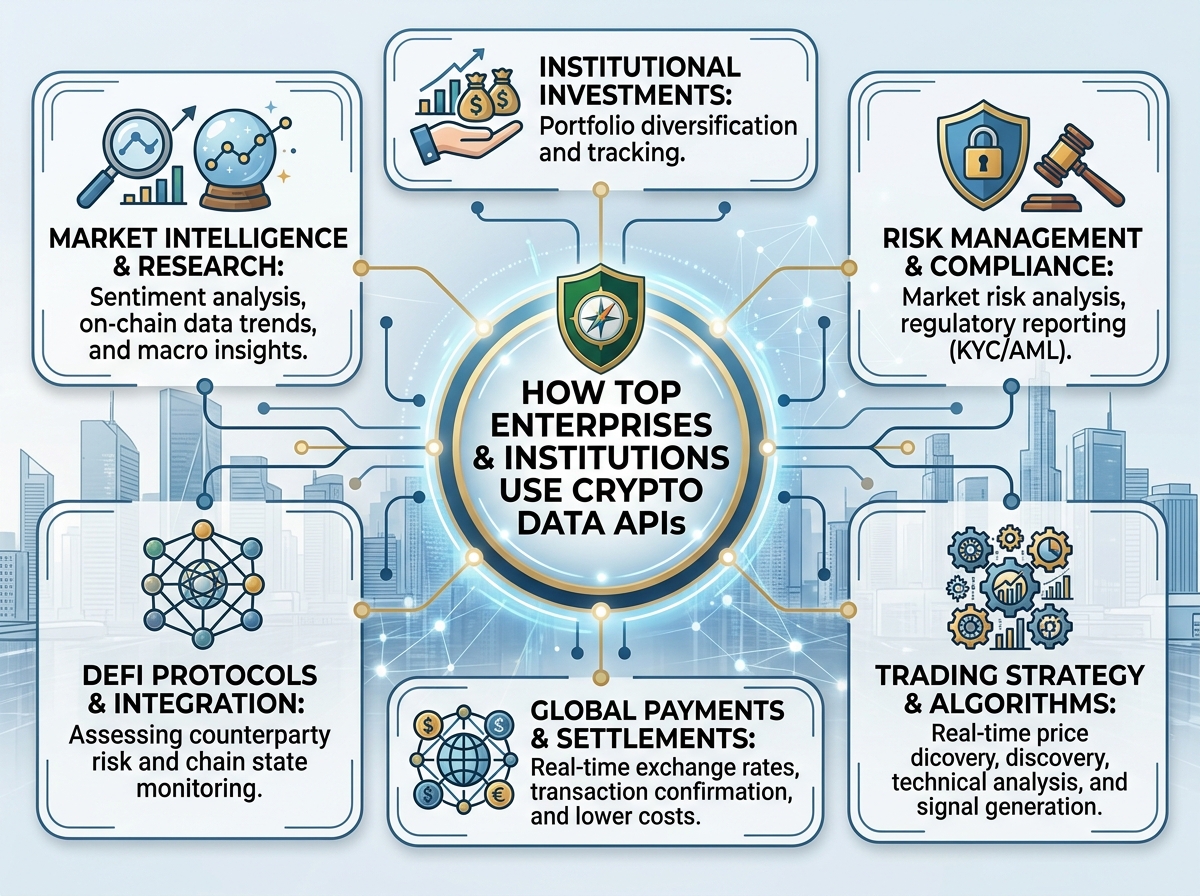
The institutional buyer usually sits inside a larger operating stack. Front-office traders need fast, clean market signals. Risk teams need exposure and volatility inputs. Finance teams need marks and reference prices. Compliance teams need wallet and entity intelligence. Operations teams need a data feed that can be replayed, reconciled, and explained. The best APIs are the ones that let those teams use the same underlying market without arguing over which version of reality is correct.
02Pricing needs a defensible benchmark
Valuation is the most visible use case, and often the most underestimated. Funds, lenders, miners, treasury desks, and accounting teams need a price series they can defend when NAV changes, collateral is re-hypothecated, or a year-end valuation is challenged. In crypto, “close” is synthetic by nature, so the methodology matters as much as the number. That is why benchmark providers publish reference rates, methodology notes, and catalog endpoints instead of just a single last-trade field.
Kaiko publishes reference rates and benchmarks through API, and its documentation explicitly distinguishes benchmark-style pricing from raw market prints. Coin Metrics provides market quotes and candles through its API, alongside catalog endpoints that tell users what history exists before they build a report or model. For institutional users, the question is not only whether BTC traded at a certain level at a certain time; it is whether the resulting series is stable enough to feed a balance sheet, a settlement process, or an independent price verification workflow. That is also why delivery format matters. A compliance report may rely on daily reference rates, while a quantitative strategy may need intraday candles and replayable tick data.
The same logic applies to products built on top of crypto markets. Exchange-traded products, structured products, lending books, and cross-margin systems all need a pricing source that can be mapped back to specific methodologies. If the mark is wrong, every downstream calculation becomes suspect. If the mark is right but undocumented, the finance team still has a governance problem.
03Compliance needs exposure, not just prices
The compliance use case is where crypto data APIs stop being convenience tools and become control infrastructure. Modern monitoring programs need to answer questions that a simple market data feed cannot answer: Which wallets belong to the same entity? Which chains carry the exposure? Is the flow direct or indirect? Does the transaction pattern fit sanctions evasion, fraud, mule activity, or laundering? TRM says strong monitoring programs use address clustering, entity risk scoring, and scenario-based detection to separate high-risk activity from normal behavior. Chainalysis’ 2026 benchmark preview says organizations are already using KYT across hundreds of firms and that financial institutions generally apply tighter alert thresholds than crypto-native exchanges.
That difference matters. A crypto-native exchange may tolerate more activity before alerting because it optimizes for customer experience and operational scale. A bank or asset manager has a different burden: prove that suspicious activity was detected early, escalated correctly, and documented consistently. In practice, that means the API is not just feeding an alert engine. It is feeding a case management process, a sanctions screening workflow, an investigation trail, and in some organizations a board-level risk dashboard.
The broader backdrop makes this more urgent. Chainalysis’ 2026 crime report introduction says sanctioned activity and other illicit categories helped push 2025 to a record year for crypto crime, even though illicit activity still represented less than 1% of attributed transaction volume. That combination is exactly why institutions care about data quality. The absolute share may be small relative to the legitimate market, but the consequences of missing a bad flow are large enough that the monitoring stack has to be built like a financial control, not like a consumer analytics tool.
04Trading and treasury need market structure data
Market data APIs are also core to execution and treasury. Traders use depth, spread, slippage, basis, open interest, and liquidation data to decide whether a position can be entered or exited without creating avoidable cost. Treasury teams use the same signals to determine whether a venue is liquid enough for policy limits, whether a stablecoin concentration is becoming risky, and how much hedge capacity exists across venues and derivatives markets.
This is where crypto differs from most traditional asset classes. The market is always open, venue quality changes quickly, and the same asset can look liquid on one exchange and fragile on another. A good API helps a desk compare venues on equal terms. It also helps product teams decide whether a token can be listed, whether a lending book can support a given asset, and whether collateral policy should be tightened after a market shock. Kaiko’s coverage explicitly includes market depth and price slippage derived from order book snapshots, while Coin Metrics exposes quotes, candles, futures, options, and market-metrics catalogs that help analysts work from the instrument level upward.
DeFi adds a second layer of operational complexity. Institutions that touch lending protocols or liquidity pools need more than price. They need borrow and deposit balances, protocol rates, token composition, and other state variables that explain how quickly a market can move from stable to stressed. That is one reason data teams increasingly pair market-data APIs with on-chain analytics instead of treating them as separate disciplines. The question is no longer “what happened on the exchange?” but “what happened across the venue, the chain, and the protocol at the same time?”
05What enterprise-grade APIs look like
The strongest crypto data APIs share a few traits that matter more in institutions than in retail apps. They provide normalized identifiers so internal systems can reconcile assets and venues. They expose both historical backfills and live streams so reports and execution systems can coexist. They publish methodology and coverage so users understand what the data does and does not represent. They support multiple delivery paths so engineers can choose REST for backfills, streaming for low-latency workflows, and warehouse-native delivery for analytics and finance teams.
Kaiko supports REST, streaming, and cloud channels, including major cloud providers and analytical warehouses. Coin Metrics supports HTTP and WebSocket access and provides catalog endpoints that let users inspect what markets, candles, quotes, and institution metrics are actually available before they wire up a pipeline. That discoverability is not a cosmetic feature. It reduces operational risk because many data failures come from hidden assumptions: a series changed its calculation, an exchange coverage set shifted, or a historical series contains gaps that were never documented.
The last requirement is governance. If a data feed is going to support valuation, monitoring, or customer-facing product decisions, it needs an owner, versioning, incident handling, and clear downstream rules. Raw data and derived analytics should be separated. If the mark changes, the team should know why. If a wallet cluster reclassifies, the analyst should be able to explain the trigger. If the pipeline fails, the business should know whether the issue is data loss, vendor latency, or a methodology update. In other words, the best crypto data stacks look like the rest of enterprise finance: controlled, observable, and boring in all the right ways.
06Practical takeaways
Enterprises and institutions use crypto data APIs to make digital assets legible to the systems they already trust. The most important jobs are not flashy: valuation, surveillance, treasury, risk, and auditability. If those are the workloads you need to support, start by deciding whether your primary need is market data, compliance intelligence, or both.
Then map the API to the control it will support. Valuation teams need repeatable benchmark logic and long history. Compliance teams need entity context, clustering, and alert tuning. Trading teams need depth, slippage, and derivatives coverage. Product and treasury teams need uptime, clear methodology, and warehouse-friendly delivery. The right vendor is not the one with the most endpoints; it is the one that makes your decisions easier to defend.
Share
Link opens on iamshuja.dev · previews show the site card
Sources
7- 01Crypto Compliance Programs in 2026chainalysis.com · 27 May 2026
- 02How Financial Institutions Can Build a Strong Crypto Transaction Monitoring Program | TRM Labs (2026-07-08)trmlabs.com
- 03Data dictionary | Developer Hubdocs.kaiko.com
- 04Reference Rates | Developer Hubdocs.kaiko.com
- 05Market Data Overview | Data Encyclopediadocs.coinmetrics.io
- 06Coin Metrics API v4docs.coinmetrics.io
- 072026 Crypto Crime Report Introductionchainalysis.com · 8 Jan 2026