GENIUS vs MiCA: did Europe just hand programmable money to the dollar?
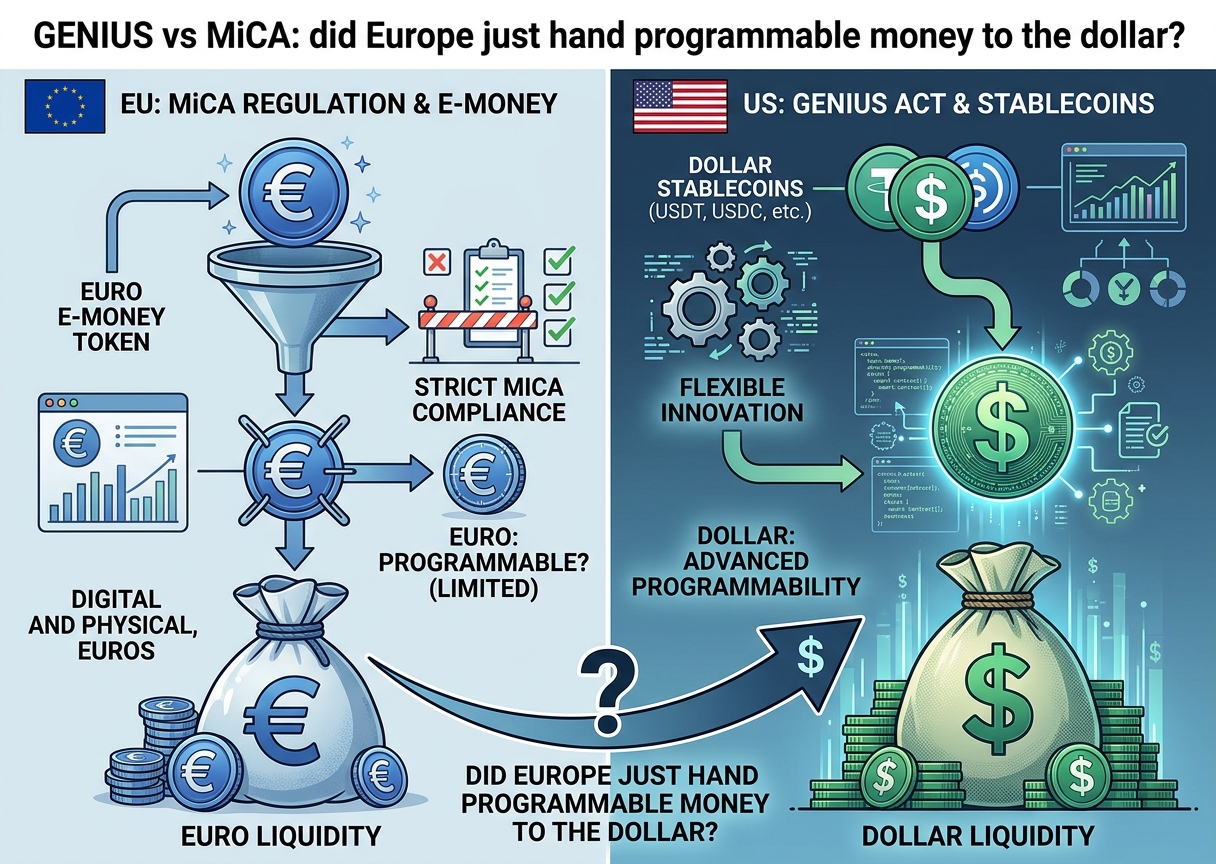
MiCA made stablecoins respectable in Europe, but not big. GENIUS gives the US a federal lane for dollar-backed payment tokens—and the real fight is now over which currency becomes the default settlement asset on-chain.
Shuja Abrar · Blockchain Consultant & Engineer
- stablecoins
- mica
- genius-act
- euro
- dollar
- payments
On this page
Programmable money does not become real because a white paper says so; it becomes real when a legal regime decides who may issue it, what backs it, and where it can settle at scale. On that test, the United States and Europe have just made different bets. The GENIUS Act gives the US a federal lane for payment stablecoins, and Treasury has already moved into rulemaking. MiCA has already given Europe a tight, bank-like regime for euro stablecoins. The uncomfortable fact is that the market is still overwhelmingly dollarized, which means the real competition is no longer about whether stablecoins exist, but which currency becomes the default settlement asset on-chain.
The headline question is whether Europe “handed” programmable money to the dollar. The honest answer is no, not by design, but it may have done something close in practice: it built a cautious framework faster than it built demand, distribution, and public-money rails that could compete with dollar liquidity. That gap matters because programmable money is not just a crypto-native curiosity. It is becoming a settlement layer for treasury management, cross-border payments, tokenized assets, exchange collateral, and increasingly for merchant and platform payments. Whichever currency wins that layer gets more than transaction volume. It gets reserve demand, fee income, data, and a new form of monetary reach.
01GENIUS makes dollars portable
The GENIUS Act is the first important US move because it removes the biggest source of ambiguity around payment stablecoins. It defines them as digital assets designed for payment or settlement, redeemable for a fixed amount of monetary value, and explicitly excludes deposits, securities, and national currency. That sounds technical, but it is the difference between a token that can live in the payments stack and a token that sits in perpetual legal uncertainty.
It also does something regulators usually avoid: it creates a federal licensing path while preserving room for state regimes. Treasury’s August 2026 proposed rulemaking says the Act’s expected effective date is January 18, 2027, at which point issuers generally may not issue a payment stablecoin in the United States without the appropriate federal or state license. The same proposal says that, starting July 18, 2028, digital asset service providers generally may not offer or sell payment stablecoins to persons in the United States unless the stablecoins are issued by a licensed issuer. In other words, the law is not merely clarifying the category; it is designing the market’s gatekeeping architecture.
The foreign-issuer piece is just as important. Treasury’s proposal says offshore stablecoins will not be freely sold into the US market unless the issuer can comply with lawful orders and any reciprocal arrangement with its home jurisdiction. That is a subtle but meaningful change. The US is no longer treating stablecoins as borderless software. It is treating them as payment instruments that need jurisdictional accountability. That makes the dollar more portable, but also more governable. If the final rules track the proposal, the US will have a framework that is friendly to innovation while still keeping the monetary unit, issuer obligations, and compliance perimeter under American control.
02MiCA made Europe safe, not large
MiCA is a different philosophy. Europe chose to regulate stablecoins as part of a broader crypto-asset framework, with e-money tokens for single-currency stablecoins and asset-referenced tokens for baskets or other reference assets. The rulebook is designed to reduce run risk, force clearer reserve management, and stop the worst form of shadow banking from entering payments under a crypto label.
The ECB’s April 2026 analysis is the clearest sign of what that has achieved. It says euro-denominated stablecoins are still tiny, with a market capitalization of around €450 million in January 2026, up from roughly €50 million at the start of 2024. The same ECB piece compares that with about $300 billion for US dollar-denominated stablecoins. That is not a gap in the second decimal place. It is a structural divide.
MiCA’s reserve model helps explain why. For euro stablecoins classified as e-money tokens, issuers must keep at least 30 percent of reserve assets with credit institutions, and 60 percent for significant issuers, with the remainder in low-risk liquid instruments such as sovereign bonds. That is a prudential design choice, and it is defensible. It makes the product more like regulated money and less like an opaque crypto promise. But it also means Europe is asking stablecoin issuers to behave like regulated financial institutions before the market has fully rewarded them with scale.
That tension is visible in the ECB’s own language. Its 2026 payment strategy says the Eurosystem wants central bank money to remain central, while private settlement assets such as tokenized deposits and euro-denominated stablecoins may complement it if they are governed by EU rules and properly designed. MiCA, in other words, is not anti-stablecoin. It is anti-fragile-stablecoin. Europe wants innovation, but only if the unit of account, reserve structure, and settlement rails stay inside a supervisory perimeter it can trust.
03Network effects beat elegance
This is where the dollar gets its edge. Stablecoin adoption is not driven only by legal certainty. It is driven by who already holds the inventory, invoices in the unit, and uses the asset in settlement. Dollar stablecoins already dominate because the dollar is the world’s trade, treasury, and collateral language. Once a tokenized payment rail is already sitting on top of USD liquidity, the path of least resistance for platforms, exchanges, market makers, and cross-border merchants is to keep using the same unit.
MiCA may have solved Europe’s compliance problem, but compliance is not the same as distribution. Euro stablecoins can now exist legally, but they still need exchanges, wallets, merchants, treasuries, and tokenized asset issuers to choose them over the more liquid alternative. That is a hard sell when most tokenized markets are already dollar-denominated and when dollar stablecoins offer deeper pools of collateral, more active market-making, and more obvious treasury utility.
The ECB’s own speeches point to the broader risk. Stablecoins can break away from their peg under stress, weaken the singleness of money, and fragment what should be a single interoperable settlement environment. That is why the Eurosystem is pushing wholesale settlement projects such as Pontes, which aim to let DLT platforms settle in central bank money. Europe understands the strategic logic. It just has not yet matched the US in creating a mass-market private instrument that can ride on top of that logic at scale.
04Europe still has options
So, did Europe hand programmable money to the dollar? Not exactly. But it may have handed the first scalable product category to the stronger currency. That distinction matters. If the base layer is compliant but thin, and the competing base layer is compliant, liquid, and already standard for offshore dollar usage, the market will usually pick the liquid one first and the elegant one later, if ever.
Europe still has three levers. It can keep making euro settlement more attractive through central bank money and tokenized public infrastructure. It can support regulated tokenized deposits and wholesale settlement tools that reduce the need for stablecoins in the first place. And it can let euro stablecoins grow enough to become useful in their own right, rather than treating them as a niche compliance product. The ECB’s strategy suggests it wants all three, but the sequencing matters. If the private market locks into USD stablecoins before Europe’s own rails mature, the dollar will have already won the default setting.
The practical takeaway for builders, compliance teams, and investors is straightforward. The question is no longer whether stablecoins are allowed. It is which currency, which issuer regime, and which settlement rail your product is really choosing. If your use case needs the deepest liquidity and the easiest path to market, GENIUS makes the dollar even more competitive. If your use case needs European regulatory alignment, MiCA gives you clarity, but not yet scale. And if you are designing the next generation of on-chain payments, the real competition is not stablecoin versus no stablecoin. It is dollar stablecoins, euro stablecoins, tokenized deposits, and central bank money fighting to become the unit that programmable commerce quietly defaults to.
Share
Link opens on iamshuja.dev · previews show the site card
Sources
5- 01Public Law 119govinfo.gov · 18 Jul 2025
- 02Treasury Seeks Public Comment on GENIUS Act Proposed Rulemaking | U.S. Department of the Treasury (2026-08-17)home.treasury.gov
- 03Euro stablecoins and their potential effect on sovereign bond marketsecb.europa.eu
- 04Stablecoins and the future of money: separating functions from instruments (2026-05-08)ecb.europa.eu
- 05Eurosystem sets out comprehensive strategy for future of European payments (2026-03-31)ecb.europa.eu