CLARITY Act died 49–50 — can agencies regulate crypto market structure without Congress?
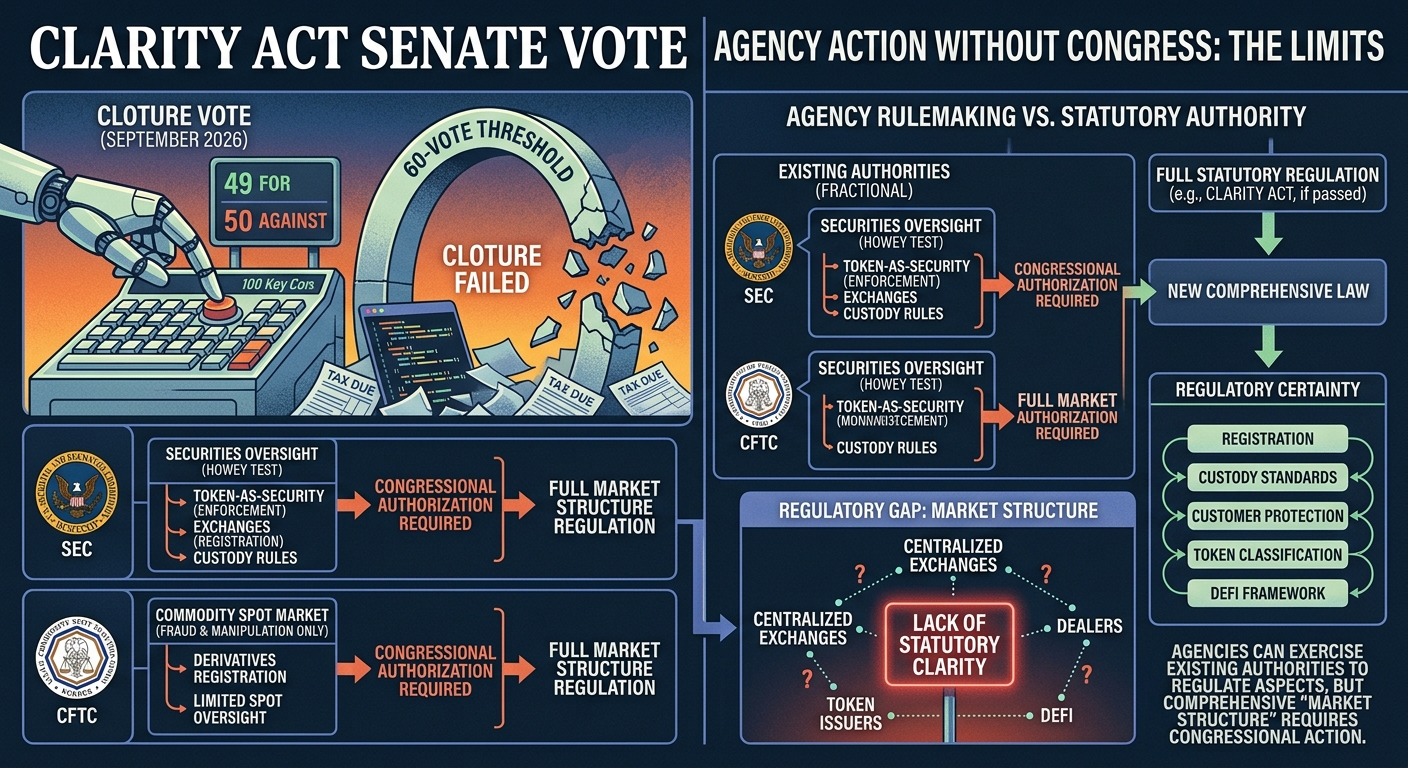
The CLARITY Act’s 49–50 Senate failure doesn’t leave crypto unregulated; it leaves regulation fragmented. Agencies can move the edges, but post-Loper Bright and West Virginia v. EPA, a full market-structure regime still needs Congress.
Shuja Abrar · Blockchain Consultant & Engineer
- crypto
- regulation
- sec
- cftc
- market-structure
On this page
The Senate did not just stall another crypto bill on September 15, 2026. It failed a 49–50 cloture vote on the CLARITY Act, which means the broad federal market-structure framework Congress had been trying to build is, for now, dead in the Senate. That leaves the industry with an uncomfortable but very real question: if Congress cannot finish the job, can the SEC and CFTC do it themselves?
The answer is yes, but only in pieces. Agencies can shape parts of crypto market structure through interpretations, venue rules, registration requirements, exemptive relief, and enforcement. They cannot, on their own, create a durable, comprehensive regime that settles every jurisdictional line the way a statute can. That is the core tension now. The political path has failed for the moment, but the legal path has limits that are sharper than many market participants want to admit.
01The vote changed the battlefield
The significance of the September 15 vote is not just that the CLARITY Act failed. It is that the Senate’s rejection forces the market to live longer with the patchwork that already exists: securities law on one side, commodities law on the other, plus a growing pile of agency guidance trying to bridge the gap. That is a very different environment from a clean market-structure statute. A law like CLARITY could have defined terms, divided jurisdiction, and set a stable path for exchanges, brokers, dealers, custodians, and token issuers. Without it, those lines remain contested.
That does not mean there is no federal regulation. It means the default mode is back to interpretation and incremental rulemaking. The SEC and CFTC have both been signaling that they intend to use their existing authorities aggressively. That is not the same thing as Congress delegating them a fresh mandate. The difference matters because crypto market structure is not a narrow technical issue. It is a foundational allocation of power between agencies, and courts treat those questions differently than routine administration.
02Agencies already have some tools
The agencies are not starting from zero. On March 17, 2026, the SEC issued an interpretation clarifying how federal securities laws apply to certain crypto assets and transactions. The release says the interpretation provides a clearer framework, complements congressional efforts, and includes a token taxonomy covering categories such as digital commodities, digital collectibles, digital tools, stablecoins, and digital securities. It also addresses airdrops, protocol mining, staking, wrapping, and when a non-security crypto asset can become subject to an investment contract analysis.
That is significant because it shows the SEC is willing to define crypto more precisely inside its own jurisdiction, rather than treating the entire asset class as a monolith. The commission is also explicitly saying that most crypto assets are not themselves securities. That kind of interpretive move does not require Congress. It does, however, remain vulnerable if the agency pushes beyond what the statutes actually authorize.
The SEC and CFTC have also taken the more practical step of aligning around venue access. In their September 2, 2025 joint staff statement, the divisions said current law does not prohibit SEC- or CFTC-registered exchanges from facilitating trading of certain spot crypto asset products. They also said that designated contract markets, foreign boards of trade, and national securities exchanges are not prohibited from facilitating such trading. That is not market-structure legislation. But it is real regulatory permission at the venue level.
A few days later, on September 5, 2025, the chairs of the two agencies said they should, where possible and appropriate under existing statutes, harmonize product and venue definitions, streamline reporting and data standards, align capital and margin frameworks, and stand up coordinated innovation exemptions using each agency’s existing exemptive authority. That is the most important clue to the agencies’ strategy. They are not claiming the power to rewrite the entire market from scratch. They are trying to knit together a workable regime from the authorities they already have.
The CFTC is moving too. On October 5, 2026, the commission’s latest news page showed that it had sought public comment on an advanced notice of proposed rulemaking relating to regulation of crypto asset transactions and crypto asset markets. Even without a final rule, that tells us the agency is not waiting for Congress to tell it whether it has a role. It is trying to define the role for itself, within the limits of the Commodity Exchange Act and its existing powers.
03But the ceiling is real
The limit is not political will; it is administrative law. In Loper Bright, decided on June 28, 2024, the Supreme Court held that courts must exercise independent judgment on whether an agency has acted within its statutory authority, and that courts may not defer to an agency interpretation simply because a statute is ambiguous. Chevron is overruled. That matters here because crypto market structure is exactly the kind of area where agencies used to rely on ambiguity, expertise, and deference to fill gaps. That playbook is now much harder to use.
West Virginia v. EPA adds another constraint. The Court said that in extraordinary cases involving highly consequential power, agencies must point to clear congressional authorization. The larger the policy significance, the less willing courts are to read old, vague text as silently granting sweeping new authority. Crypto market structure looks a lot like that kind of case if the SEC or CFTC tries to assemble a broad federal framework from statutes never designed to cover the entire digital-asset stack.
This is why the phrase “existing authorities” appears so often in agency statements. It is an admission of scope. Agencies can interpret the laws they administer, supervise registered venues, police fraud and manipulation, define disclosure and reporting obligations within their lanes, and grant limited relief. They can probably do more of that than many people think, especially where the legal question is narrow and the statutory text is concrete.
What they probably cannot do is invent the kind of whole-of-market settlement that Congress would have supplied. They cannot, by interpretation alone, permanently resolve whether a token is a security, a commodity, or something else for all purposes. They cannot create a single statutory perimeter for issuance, trading, custody, leverage, and disclosure that survives serious judicial review unless the underlying statutes already support it. And they cannot eliminate the jurisdictional seams between the SEC, the CFTC, banking regulators, and state regimes without clear legislative backing.
That is why a post-CLARITY world is likely to be messy. Agencies can regulate fragments of the market, and they will. They can harmonize where the law gives them room, and they are already trying. But a true market-structure regime is a legislative product, not an administrative accident. If Congress stays blocked, the market will not be unregulated; it will be regulated in layers, with more litigation, more venue-specific guidance, and more reliance on agency discretion that courts can still overturn.
04What firms should expect
The practical takeaway is straightforward. Firms should not assume the failure of the CLARITY Act means a regulatory vacuum. The SEC and CFTC are already filling parts of the space with interpretations, joint statements, and proposed rules. But they should also not assume agencies can quietly substitute for Congress. Under current Supreme Court doctrine, the bigger the regulatory leap, the more likely a court will demand a clearer statutory basis than agencies may have.
For builders and compliance teams, the right planning assumption is not “no rules until Congress acts.” It is “fragmented rules now, contested rules later, and a real chance that the boundary lines get rewritten by judges.” That is a harder environment than a statute would have provided, but it is the environment the 49–50 vote left behind.
Share
Link opens on iamshuja.dev · previews show the site card
Sources
7- 01U.S. Senate: Cloture Motionssenate.gov
- 02SEC-CFTC Joint Staff Statement (Project Crypto-Crypto Sprint) (2025-09-02)sec.gov
- 03Joint Statement from the Chairman of the SEC and Acting Chairman of the CFTC (2025-09-05)sec.gov
- 04SEC Clarifies the Application of Federal Securities Laws to Crypto Assets (2026-03-17)sec.gov
- 05LATEST NEWS | CFTC (2026-10-05)cftc.gov
- 06Loper Bright Enterprises v. Raimondo (2024-06-28)supremecourt.gov
- 07West Virginia v. EPA (2022-06-30)supremecourt.gov