Attribution standards: when is it fair to publicly name a launderer?
Publicly naming a launderer is fair only when identity, evidence, and public need all clear a high bar. The line between responsible attribution and reckless accusation is narrower than most teams think.
Shuja Abrar · Blockchain Consultant & Engineer
- money laundering
- attribution
- compliance
- sanctions
- on-chain analytics
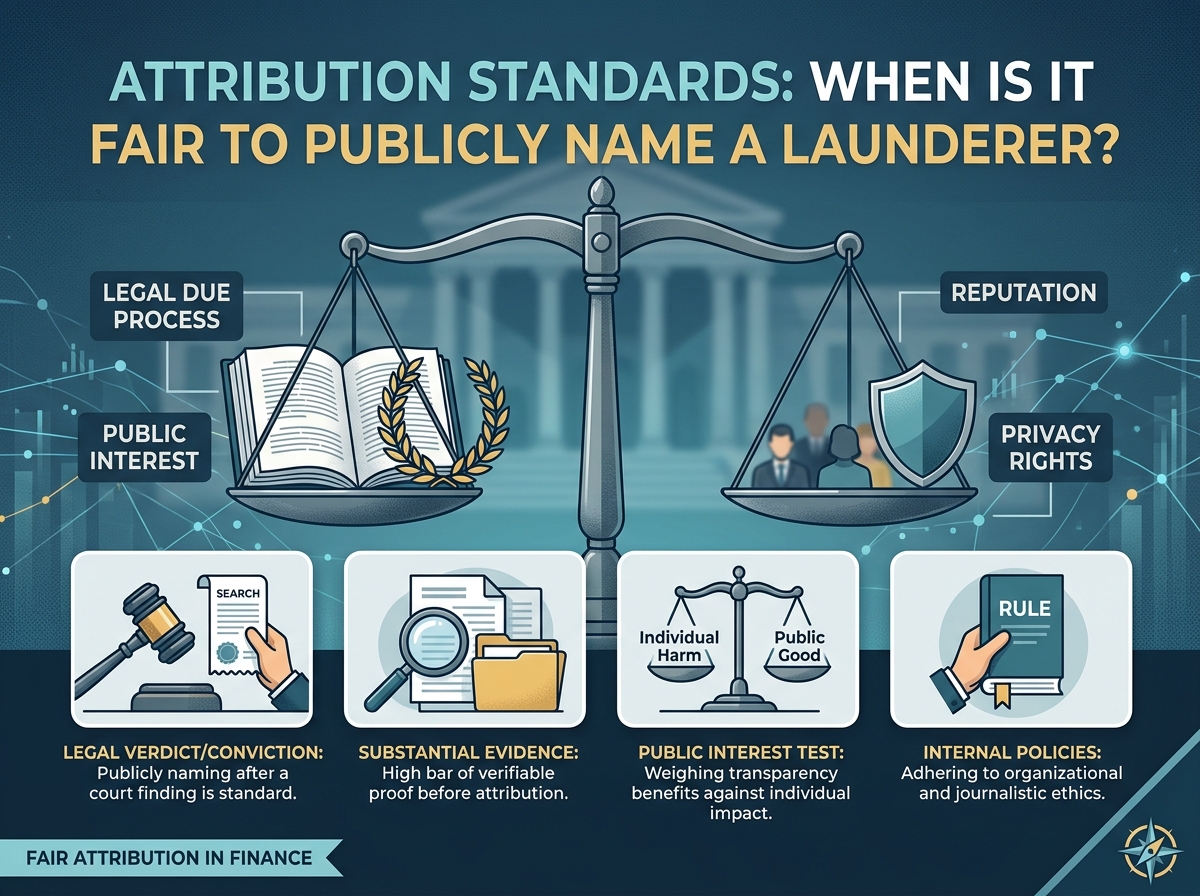
Publicly calling someone a launderer is not the same as accusing them in a private memo. Once the label goes out, it can freeze bank access, trigger sanctions screening, destroy business relationships, and shape how journalists, counterparties, and even jurors interpret later facts. That is why the real question is not whether a person is suspicious. The question is whether the identity is verified, the evidentiary basis is explainable, and the public interest in naming them is strong enough to justify the reputational cost.
The cleanest standard is simple: name a person only when you can do more than connect them to a transaction pattern. In money laundering, the pattern is often easier to see than the person. Wallet clusters, shell companies, nominee directors, and shared infrastructure can all be real evidence, but they are not automatically proof of who controlled the value or who directed the scheme. FATF’s beneficial-ownership guidance makes the core problem explicit: criminals use corporate vehicles to disguise identity and source of funds, which is exactly why accurate, up-to-date ownership information matters. If the evidence only shows that an address, company, or account was used in laundering, say that. Do not convert a trace into a person unless the link is strong enough to survive hostile review.
That is where attribution discipline matters. A careful public statement separates three layers: the object traced, the entity controlled, and the human being alleged to be responsible. A wallet may be associated with a cluster. A cluster may be associated with an exchange, bridge, scam ring, or shell company. A company may be controlled by an ultimate beneficial owner. Only at the last step do you have a person. If you skip those steps, you are not doing attribution; you are collapsing inference into fact. Fair naming means being precise about what is known, what is inferred, and what remains uncertain.
The next threshold is procedural. In U.S. practice, the government’s own media policy draws a bright line around uncharged people. DOJ’s Justice Manual says public statements should balance fair-trial interests, privacy, public safety, and public access, and it says that, absent significant justification, it is not appropriate to identify an uncharged party by name in public filings or proceedings. It also says that, after a case ends, public disclosure of uncharged parties requires approval and must be justified by legitimate and compelling interests that outweigh privacy and reputational harms. That is not just bureaucratic caution. It is the core fairness principle: public naming is easier to justify once a court, prosecutor, or regulator has already made the allegation on the record.
That is why a formal charge, indictment, or sanctions designation is usually the most defensible point at which to name someone publicly. It does not mean the person is guilty in the moral or criminal sense. DOJ press materials still remind the public that charges are allegations and that defendants are presumed innocent. But a formal public filing or designation changes the epistemic baseline. The claim is no longer merely an analyst’s conclusion. It has been tested through a legal process that requires a known standard, a named authority, and a record that can later be challenged. In practical terms, that makes public naming fairer, because the target gets notice, the audience gets context, and the statement is tethered to an official process rather than to private certainty.
OFAC’s current process illustrates the same point from a sanctions angle. When OFAC lists a person or property, it publishes that action publicly, but it also provides an administrative reconsideration process and a petition path for removal. That matters because a public designation is serious without being final in the way a criminal conviction is final. It is an official finding, but it is also reviewable. Fairness here means two things at once: the government can publicize the designation because it has operational and national-security consequences, and the listed person can still ask OFAC to reevaluate the basis for the action. If you are going to repeat that designation publicly, you should treat it as an official determination, not as an irreversible moral verdict.
The hardest case is when there is no charge, no designation, and no conviction, but the network is active and the harm is ongoing. This is the one context in which public naming before formal process can still be fair, but only under a higher bar. DOJ’s own standard says the interests served by disclosure must be legitimate and compelling, and they must substantially outweigh the privacy and reputational interests of the uncharged party. In practice, that means the public naming should be necessary to protect victims, stop active laundering, warn counterparties, preserve the integrity of an investigation, or prevent imminent harm. If disclosure is just useful, do not do it. If disclosure is necessary, disclose only the minimum required to achieve the protective purpose.
That minimum should be narrower than many teams think. A responsible disclosure often names the scheme, the entity, or the wallet cluster and avoids naming a natural person until the identity link is fully supported. It also avoids language that implies certainty where the evidence is still probabilistic. Good attribution can sound slightly less dramatic because it is more honest: “we assess,” “we believe,” “we attribute with high confidence,” or “this address is associated with” are not evasions. They are precision tools. They tell the reader what kind of claim is being made and what level of proof underlies it. If your method cannot support that kind of precision, you probably should not be naming a person at all.
There is also a correction duty. The fair standard is not just about how you name someone the first time. It is about how quickly you update or retract when the evidence changes. If a chain-analysis lead turns out to be a mule, if a nominee director is exposed as a real controller, or if an official designation is later removed, the public record should reflect that change clearly. OFAC’s reconsideration process exists for that reason, and any serious investigative or compliance team should build the same habit internally. Public naming is only fair if the organization is willing to revise the name when the facts move.
The practical rule is narrower than the rhetoric around financial crime: publicly name a launderer when the identity is verified, the claim is anchored in a formal process or a defensible evidentiary record, and the public benefit outweighs the harm. If you cannot satisfy those conditions, name the transaction, the wallet, the entity, or the network instead. Precision is not softness. It is what keeps anti-money-laundering work credible.
For compliance teams, that means creating internal thresholds for when an attribution can move from “suspected,” to “probable,” to “publicly actionable.” For journalists and analysts, it means distinguishing between a traced asset flow and a named human being. For founders, exchanges, and investigators, it means documenting the basis for attribution as carefully as the transaction itself. The standard is not whether you can say a name. The standard is whether you should, and whether you can defend saying it in public after the first wave of scrutiny has passed.
Share
Link opens on iamshuja.dev · previews show the site card
Sources
6- 01Justice Manual | 9-27.000justice.gov
- 02Justice Manual | 1-7.000justice.gov
- 03897 | Office of Foreign Assets Control (2026-06-29)ofac.treasury.gov
- 04How to Request Removal from an OFAC Sanctions List | Office of Foreign Assets Controlofac.treasury.gov
- 05Guidance on Transparency and Beneficial Ownershipfatf-gafi.org
- 06Treasury Sanctions Brazilian Criminal Network Exploiting U.S. Financial System to Launder Drug Proceeds | U.S. Department of the Treasuryhome.treasury.gov