Arbitrum’s Security Council froze $75M of KelpDAO loot — feature or fatal flaw?
Arbitrum’s KelpDAO freeze was a real emergency response, not a stunt. But it also exposed the core tradeoff in Arbitrum’s design: rescue power versus hard immutability.
Shuja Abrar · Blockchain Consultant & Engineer
- arbitrum
- kelpdao
- defi
- governance
- security
- bridges
On this page
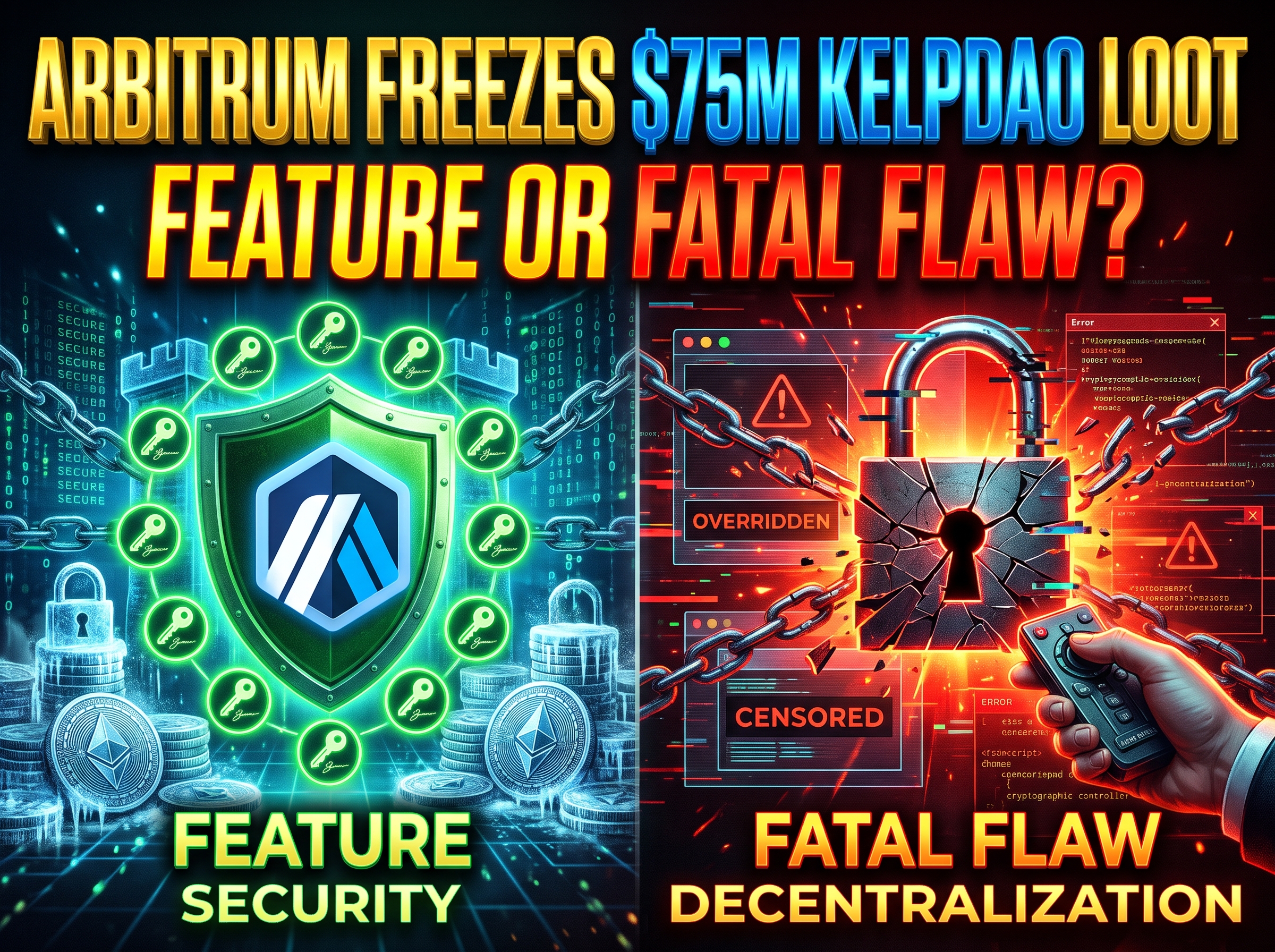
Arbitrum’s April 2026 freeze of roughly 30,765 ETH tied to the KelpDAO exploit is important for one reason above all: it shows that a rollup can be built with a credible emergency brake, but that same brake is a direct challenge to the idea that onchain systems are supposed to be unstoppable. The Security Council did not simply warn users or publish a postmortem. It reached into the protocol, immobilized stolen funds, and changed the attacker’s practical control over them. That is either a feature of a mature governance system or a fatal flaw in a system that claims to be decentralized, depending on what you think Arbitrum is for.
01What actually happened
The KelpDAO incident began on April 18, 2026, when the rsETH bridge suffered a crosschain exploit that ultimately drained 116,500 rsETH, or about $292 million at the time. LayerZero’s incident report says the attack hinged on a compromised operational environment and a risky bridge configuration: the application had been set to a single-verifier model, so one signed attestation was enough to authorize the message that released funds. In other words, the failure was not a simple smart contract bug in isolation. It was a design and operations failure that let an attacker manufacture the equivalent of a valid crosschain instruction.
That distinction matters. Security audits tend to focus on contracts. This incident showed how much of DeFi’s real risk sits around the contracts: RPC infrastructure, key hygiene, signer configuration, and the assumptions that sit between chains. Once the attacker had minted unbacked claims and converted them into real assets, the damage moved quickly across venues and chains. A freeze on Arbitrum could only ever solve part of the problem.
02How Arbitrum froze funds
On April 21, 2026, Arbitrum’s Security Council executed an emergency action to freeze 30,765.667501709008927568 ETH held by the KelpDAO exploiter on Arbitrum One and moved it to a governance-controlled address. The official forum post says the funds were placed at 0x0000000000000000000000000000000000000DA0 and could only be moved by a later Arbitrum governance action. The council described the move as an atomic action: it temporarily upgraded the Ethereum inbox contract, added a function that could impersonate the sender of a crosschain message, used that function to transfer the funds, and then restored the contract to its original implementation.
That technical description is the heart of the debate. Arbitrum did not pretend the attacker’s private key had magically vanished. It used a privileged governance path to make the stolen ETH inaccessible to the attacker. The protocol’s own documentation says this is exactly what the Security Council exists to do: act quickly to fix critical vulnerabilities in DAO-governed chains. Emergency actions require 9 of 12 members to sign and take effect immediately, while non-emergency actions are delayed to give users a withdrawal window. The council is not an accident in the architecture. It is the architecture.
03Feature or fatal flaw
If your standard is user protection, the freeze looks like a feature. Without it, the attacker would have kept control of a large, liquid pile of ETH on Arbitrum and could have laundered or bridged it elsewhere. The council’s action gave KelpDAO, Aave, LayerZero, EtherFi, Compound, and other parties time to coordinate recovery. It also reduced the chance that the stolen funds would continue to leak through the market in a way that made losses harder to absorb. For institutions, compliance teams, and most users who care about recovery rather than ideology, that is not a bug. It is exactly what they want governance to do when something breaks.
If your standard is censorship resistance and immutable settlement, the same action is deeply uncomfortable. The council did not wait for a broad onchain vote. It did not rely on a court order before immobilizing the funds. It used special-purpose powers delegated by DAO governance to override the normal finality assumptions of the rollup. That means Arbitrum is not a place where every account is equally sovereign under all conditions. In extreme cases, a small elected body can supersede the attacker’s control and, by extension, the ordinary expectations of anyone who treats “decentralized” as synonymous with “no one can intervene.”
The strongest criticism is not that Arbitrum has this power. It is that many users still underestimate what that power implies. A rollup with an emergency council is not the same product as a rollup with no override path. The former can rescue users, unwind some failures, and coordinate around systemic incidents. The latter offers harder guarantees, but at the cost of leaving losses to play out in full. Builders need to decide which model they are actually shipping. Marketing language that blurs the distinction does users no favors.
04The legal and practical bill
The freeze was only the first act. On April 25, 2026, a Constitutional AIP asked Arbitrum governance to release the frozen ETH into a coordinated recovery effort intended to make affected rsETH holders whole. That proposal was not a casual afterthought; it came with indemnification language aimed at shielding the Foundation, Offchain Labs, the Security Council, and individual members from claims tied to the freeze and the release. That is a sign that emergency powers are never just technical. Once a council intervenes, legal risk, custody risk, and governance risk all arrive together.
The broader market also learned a second lesson: freezing assets on one chain does not reverse a multichain exploit. FATF’s 2026 DeFi report treats the KelpDAO case as evidence that roughly $75 million was frozen while the rest of the proceeds were laundered through crosschain infrastructure such as THORChain. That is the uncomfortable reality of incident response in DeFi. Emergency powers can contain one shard of the damage, but they cannot erase the exploit or stop the attacker from using other railways.
Arbitrum’s own governance docs make this tradeoff explicit. The Security Council is a 12-member committee elected by the DAO, split into two cohorts, with annual elections and a mandate to move fast in emergencies. The DAO can remove members, alter the council’s powers, or even curtail the council’s authority through constitutional governance. So the real question is not whether the council exists. It is whether the DAO keeps it narrow, accountable, and transparent enough that the emergency brake does not become a permanent steering wheel.
The fact that Arbitrum later used the same style of emergency response again in October 2026, when the council froze funds tied to the Binance exploit, shows that KelpDAO was not a one-off exception. The mechanism has become part of Arbitrum’s incident response playbook. That may reassure users who want quick containment. It may worry those who believe a rollup should be politically and technically harder to intervene in.
The practical takeaway is straightforward. If you build on Arbitrum, assume the Security Council can and will act in a crisis, and model that into your risk disclosures, treasury policy, and user expectations. If you invest in or govern a protocol on Arbitrum, do not confuse emergency recoverability with trustlessness. And if you are comparing chains, judge them honestly: some systems optimize for irreversible finality, others for survivable failure. Arbitrum’s KelpDAO freeze is proof that the council is a feature. Whether that feature is acceptable depends on whether you think the point of a blockchain is to be hardest to change or safest to rescue.
Share
Link opens on iamshuja.dev · previews show the site card
Sources
6- 01Security Council Emergency Actionforum.arbitrum.foundation · 21 Apr 2026
- 02ArbitrumDAO FAQs | Arbitrum DAOdocs.arbitrum.foundation
- 03The Amended Constitution of the ArbitrumDAO | Arbitrum DAOdocs.arbitrum.foundation
- 04LayerZero External Incident Report [FINAL] (2026-05-18)layerzero.network
- 05Targeted report on regulatory challenges from decentralised financefatf-gafi.org
- 06[Constitutional] AIP: Approve Release of Frozen ETH (2026-04-25)forum.arbitrum.foundation